Thanks to Michaela Stankova for her story on my research in The Slovak Spectator: http://www.spectator.sk/articles/view/30859/12/far_more_than_a_research_project.html
She did a good job of transforming a rambling interview into a coherent narrative.
For those who just can’t get enough, the full interview is on our Goat Street blog: http://bridgetmail.wordpress.com/2008/03/01/why-i-am-here-more-or-less/
Tag: Slovakia
Exit, [Void] and Loyalty
(or why Dr. Sean hits the nail on the head)
Kudos to Sean Hanley for his recent post, Do Slovak and Czech Christian Democrats have a prayer? Dr. Hanley, whose blog (Dr. Sean’s Diary, http://drseansdiary.blogspot.com/) has long been my model for public, academc discourse on postcommunist Europe, yet again calls attention to precisely the questions I am trying to think about. Not only does he do an an excellent job of covering the dilemmas of the Christian Democrats in the Czech Republic, a realm that nobody knows better than he, but he also offers provocative thoughts about intra-party struggles, coalitions and election results in Slovakia:
And generational renewal? Commentators and politicians in CEE are always harping on about this, but it’s hard to see quite newer or younger will necessarily mean better. Such comments are, usually a disguised call for in political renewal or cleaner, better, more liberal government – amen to that, but even though there is no primaries system there is ample scope for new parties to emerge or young technocrats to parachute themselves into organizationally weak, elite-led parties. The Slovak experience suggests that many voters don’t want renewal of this kind, but stability. Is the Slovak Barack Obama actually Robert Fico?
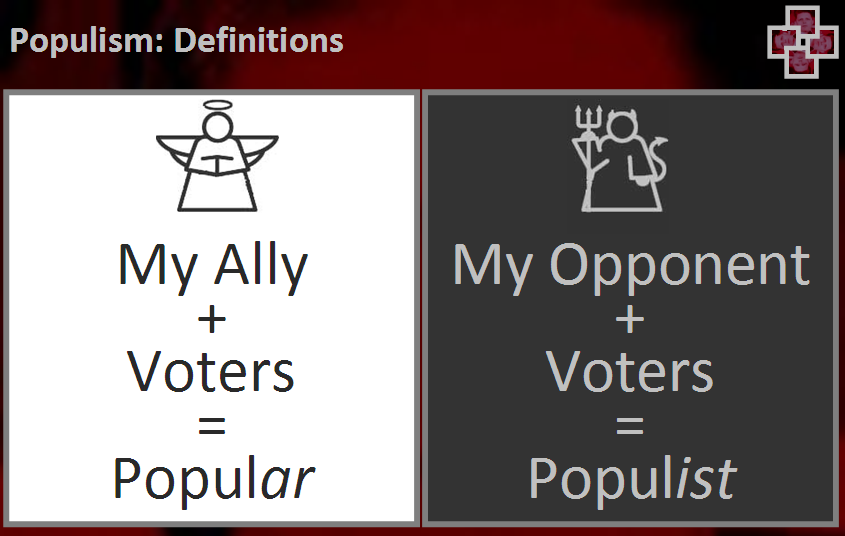
Though the comparison may not be desirable to some partisans of Obama or of Fico, there are important similarities that must not be overlooked. I continue to wrestle with the concept of “populism” since in its common usage it is both vague and highly normative:
Populism
But if populism does mean anything–and I think it does mean something despite all of the accretions over time–it is a sense that politics is broken. It is a feeling (though not quite an ideology) that those in public office–both those in power and those in opposition–are the cause of the problem. By this standard, of course, nearly every American politician is a populist, but if you compare them to many of their European counterparts, that is actually a fairly accurate characterization. While I have not done the spadework to explain why, I suspect that America’s relative exceptionalism in this regard has a lot to do with its presidential system, the dominant role of media, the relative absence of party organization. Many European countries are moving in this direction, however and postcommunist Europe appears to be in the vanguard. In this sense, both Fico and Obama have become preferred choice for those voters who are tired of “politics as usual” and who seek something different. Those are different kinds of voters compared to their overall electorates, but that is a different story.
Party renewal
There is a lot more to say about the question of populism, and I hope to do so over the coming months. In the meantime, however, I want to point out one very important difference between Obama and Fico and one that goes to the heart of Prof. Hanley’s question: Barack Obama is still a member of the Democratic Party and it is hard to imagine him leaving the party if he loses the nomination; Robert Fico, on the other hand, left his original party and formed a new one.
Fico is not alone in this. Indeed questions of internal-party change and party defection are central to the course of Slovakia’s politics and to the politics of many countries in the region. Dr. Hanley is right to point out that the question is not whether parties can achieve generational change; renewal can easily occur within a single generational cohort. Rather, the question is whether renewal can occur within a single party. Two phenomena mark Slovakia’s political party system: the relative infrequency of institutionalized leadership change and the relative frequency of party splits and splintering.
Loyalty: The Rarity of Party Leadership Change
Parties in Slovakia rarely change leaders and they almost never undergo institutionalized leadership transitions. Among Slovakia’s current parliamentary parties. As the table below shows, the average tenure of the chairmen of Slovakia’s current parliamentary parties is between 8 and 9 years (depending on the method of calculation), and this represents an average of 67%-71% of their parties’ respective lifespans.
| Party | Founding Date | Number of leaders since founding | Current leader | Date assumed leadership | Duration of leadership | Length of leadership as % of length of party existence |
| Party of the Hungarian Coalition (MKP/SMK) | 1990 | 2* | Pal Csaky | 2007 | 1 year | 6% |
| Christian Democratic Movement (KDH) | 1990 | 2 | Pavol Hrusovsky | 2000 | 7 years | 41% |
| Slovak National Party (SNS) | 1990 | 5 | Jan Slota | 1994 | 9 years/13 years** | 53%/76%** |
| Movement for a Democratic Slovakia (HZDS) | 1991 | 1 | Vladimir Meciar | 1991 | 16 years | 100% |
| Smer | 1999 | 1 | Robert Fico | 1999 | 8 years | 100% |
| Slovak Democratic and Christian Union (SDKU) | 2000 | 1 | Mikulas Dzurinda | 2000 | 7 years/9 years*** | 100% |
| Mean scores | 1993 | 2 | – | 1999 | 8-9 | 67%-71% |
| http://www.terra.es/personal2/monolith/slovakia.htm* Party formed from merger of Hungarian Christian Democratic Party (MKDM) and Coexistence in 1998 **Jan Slota rejected his removal in 1999 and formed the rival “Real” Slovak National Party (PSNS) during his period out of leadership in SNS. ***Mikulas Dzurinda led the Slovak Democratic Coalition before leading the SDKU |
||||||
Indeed three parties, Smer, SDKU-DS and HZDS (which together hold almost 2/3 of the deputies in parliament), have had the same leader for their entire existence. The same is true in practice for several significant parties that are currently no longer represented in parliament (ZRS, ANO). Other parties have undergone leadership transition by default as founding party leaders became president (SOP, HZD) or withdrew from politics (KDH). Only a handful of parties have enjoyed (though for them, “enjoy” may not have been the right word) contested leadership struggles that actually changed the course of party leadership. The Party of the Hungarian Coalition (MKP/SMK) resolved internal leadership questions when it formed from its component parties in 1998 and underwent a leadership shift again in 2007. The Party of the Democratic Left (SDL) underwent major leadership transitions in 1996 and 2001. The Slovak National Party (SNS) is the closest to demonstrating regular leadership change (1990, 1992, 1994, 1999, 2003) but change in party leadership after 1992 has been fraught with difficulty and appears for the moment, to be at an end.
Exit: The Frequency of Party Splintering
New party leaders in Slovakia are more likely to be leaders of new parties than new leaders of old parties. Whereas the six parties listed above have collectively only experienced seven or eight leadership changes (depending on calcuations), they have collectively experienced at least ten significant splits and splinters of parliamentary deputies or prominent party leaders. Secession is far more common than succession. It is difficult to find struggles between party incumbents and party insurgents that have left a party intact: SDL in 1994 (to the extent that Peter Weiss’s withdrawal was not entirely voluntary), SNS in 1992 and 2003, and MKP/SMK in 2007. Far more common is struggle followed by departure of the loser to form a new party: SNS in 1994 and 1999, SDL in 1999 and 2001 (and, to the extent there was a real struggle, with the departure of Luptak in 1994), KDH in 1991, 2000 (related to the dissolution of the SDK coalition) and 2007 (just last week, in fact), SDKU in 2003 and the seemingly annual HZDS splinters in 1993, 1994, 2002, 2003, (and in miniature formjust recently). In fact the only parties in which party struggles have not led to departure are the Hungarian Coalition (which is limited by the inability of Slovakia’s 11% Hungarian population to support two parties that can overcome the 5% threshold), new parties that have died before a split could occur (SOP, ANO, ZRS) and a variety of smaller parties that never by themselves passed the 5% threshold (indeed Slovakia’s small parties such as the show more robust leadership rotation and a greater ability to survive leadership struggles, perhaps because they are too small to lose any members without disappearing entirely. See The People’s Front of Judea).
Why do Slovakia’s parties splinter so easily? This is a complicated and fascinating question that I am currently working on in greater detail. Institutional barriers to entry for new parties are low, but not much lower than in other parliamentary/proportional-representation systems in Europe. A stronger answer may lie in perceptions of cost and benefit. The perception of departing may be relatively low in Slovakia because certain splinters have demonstrated electoral success (DU and ZRS in 1994, Smer in 2002) and other parties have demonstrated an ability to go from nowhere to election in a matter of months (SOP, ANO). I do not, however, have the evidence to say whether these cost perceptions are lower than in countries with fewer splinters. The second part of the answer may lie in the perceived costs of remaining within a party. This in turn relates to the perceived absence of voice.
Voice: It’s (Not) My Party
My initial observations suggest that Slovakia’s centralized party organizations make it difficult for dissenters to remain. When parties remain in the hands of their founders, as in the case of Smer, HZDS and SDKU, or become tightly bound up with a successive leader, as in the recent case of SNS, those who wish to change the party may have no choice but to go elsewhere, particularly if they openly challenge the leadership. The strength of this conclusion is mitigated somewhat by the fact that even the more collegial SDL and KDH have produced a significant share of Slovakia’s splinters, and even some in the vulnerable Hungarian Coalition appear to have considered departure. Nevertheless, it is hard for me to believe that structures more conducive to internal democracies, structures that took party control out of the hands of the founder, could produce more renewal and fewer departures. I have not read Hirschmann in a long time, but it seems like introducing genuine opportunities for voice could provide an alternative both to frustrated loyalty and to destabilizing departure.
In this regard, recent discussions within the current opposition are a very positive sign. It would appear that the current infighting within parties that are already at a low point in their political fortunes will only make matters worse–and in the short run this is true–but in the long run, the kinds of discussions emerging among second-rank leaders in SDKU, KDH and MKP/SMK are potentially conducive to long-term survival, party renewal (much needed) and electoral success. By this standards the current governing parties have a short-term advantage in internal cohesion, but are at greater risk of long-term difficulties because they include some of the most centralized parties that Slovakia has ever seen. In terms of broader patterns, the news is good because it is potentially quite normal: parties in power put themselves at risk by failing to adapt; parties out of power learn how to renew themselves and eventually rise to the challenge. If Slovakia’s current opposition can manage to find mechanisms for voice and reform from within, Slovakia could experience the novelty (for Slovakia, at least) of an opposition-coalition struggle that is not also the struggle between old parties and new.
Popularity of Departing KDH Deputies
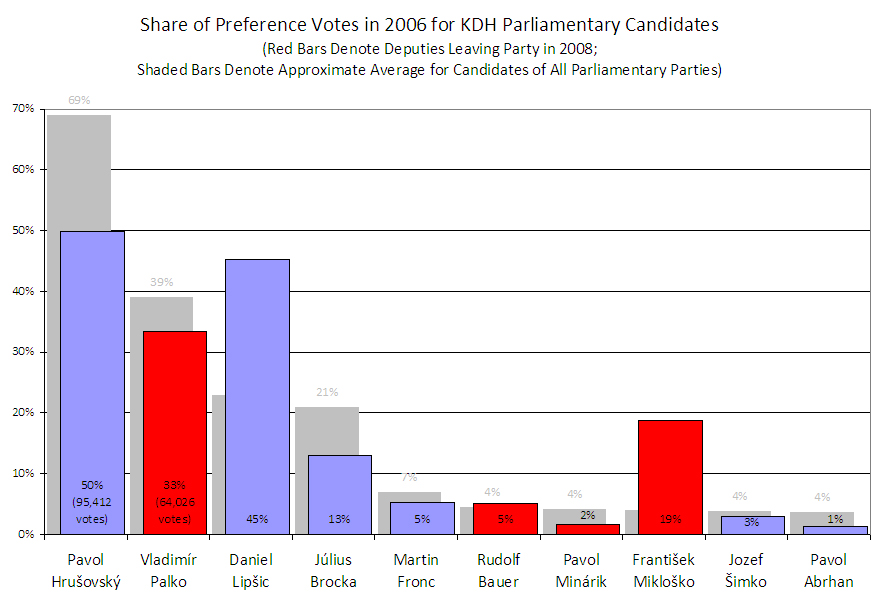
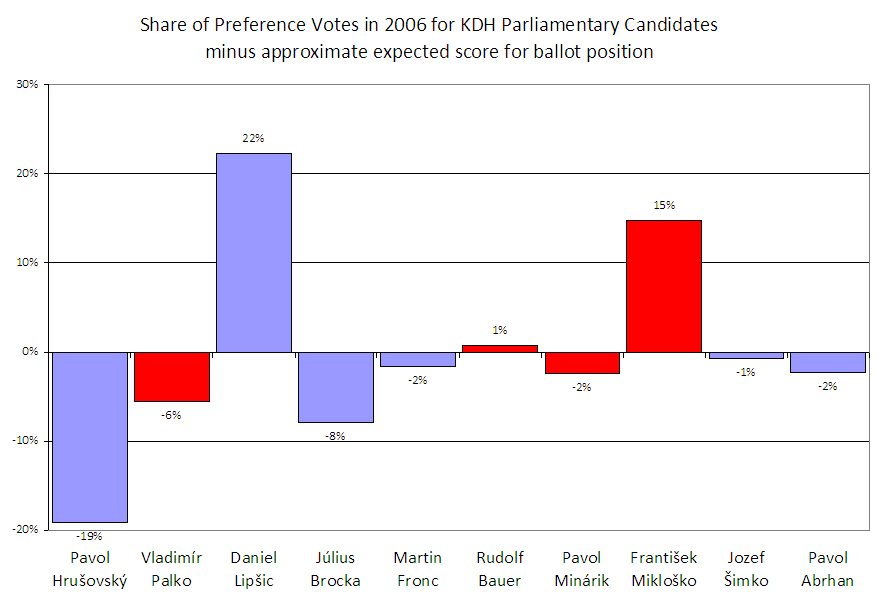
On the day after SDKU members began talking about publicly changing leadership, KDH members began publicly leaving the party after apparently failing to produce a leadership change. I will leave this to others to discuss in detail, but do here what I am prone to do: offer rather facile quantitative evidence of qualitative developments. In this case, I offer a numerical view of the popularity of the departing KDH members. Of course ballot position plays a role as well (as voters tend to tick off candidates in order going down)., and so any meaningful assessment requires a comparison to the baseline effects of ballot position. Full data is below but for clarity, I present the following two graphs which in different ways show the same thing: that the departing deputies were neither significantly more nor significantly less popular than those who stayed.
Source: http://www.statistics.sk/nrsr_2006/slov/index.jsp?subP=v
With the exception of Daniel Lipsic, that the KDH deputies who have not joined the departing four did tend to underperform (in terms of popularity) the deputies of other parties at similar ballot positions, particularly Hrusovsky. This is also true, however of two of the four departing candidates, particuarly Palko. Among the departing 4, only Miklosko demonstrated a popularity that was out of proportion with his position on the ballot, though this may have been the result of his under-placement there. In popularity terms, the outgoing four thus include 2 of the top 4, but their aggregate popularity would appear to be less than that of the two popular figures who remain (even as Hrusovsky underperformed and Lipsic overperformed).
Source: http://www.statistics.sk/nrsr_2006/slov/index.jsp?subP=v
It is hard for me not to note here that the graphic presented by SME, while much more attractive, does not convey the same information, not only not placing the numbers in context (or even giving percentages) but not even allowing rapid comparison of where the departing deputies stood relative to those remaining (for more on this kind of visual analysis of statistical information, see http://junkcharts.typepad.com/and http://infosthetics.com/)
http://www.sme.sk/vydania/20080222/photo/1kdh.jpg
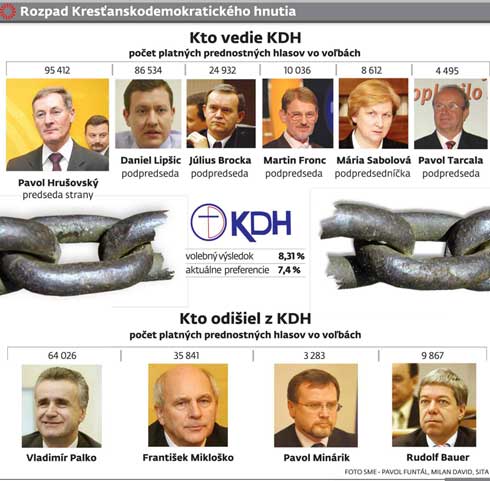
| Meno a priezvisko kandidáta [Name] | Počet platných prednostných hlasov [Number of preference votes] | Poradie po zohľadnení prednostného hlasovania [ Order determined by preference voting] | Poradie na kandidátnej listine [Position on original candidate list] |
|---|---|---|---|
| Pavol Hrušovský | 95412 | 1 | 1 |
| Daniel Lipšic | 86536 | 2 | 3 |
| Vladimír Palko | 64026 | 3 | 2 |
| František Mikloško | 35841 | 4 | 8 |
| Július Brocka | 24932 | 5 | 4 |
| Martin Fronc | 10036 | 6 | 5 |
| Rudolf Bauer | 9867 | 7 | 6 |
| Mária Sabolová | 8612 | 8 | 19 |
| Peter Gabura | 8527 | 9 | 77 |
| Monika Gibalová | 6485 | 10 | 33 |
| Stanislav Kahanec | 5889 | 11 | 22 |
| Pavol Minárik | 3283 | 12 | 7 |
Source: http://www.statistics.sk/nrsr_2006/slov/index.jsp?subP=v
February 2008 UVVM: Smer near record high
It is hard to tell the same story in an interesting way every month (and maybe this is why Slovak papers, which unlike me have competing demands and limited space, do not tell the story at all). First the numbers:
| Politický subjekt: | december 2007 | január 2008 | február 2008 |
|---|---|---|---|
| SMER- sociálna demokracia (SMER) | 45,2 | 43,9 | 45,4 |
| Slovenská demokratická a kresťanská únia – DS (SDKÚ-DS) | 13,5 | 14,7 | 12,5 |
| Slovenská národná strana (SNS) | 11,2 | 14,0 | 12,4 |
| Strana maďarskej koalície-Magyar Koalíció Pártja (SMK-MKP) | 7,6 | 8,0 | 9,8 |
| Ľudová strana – Hnutie za demokratické Slovensko (ĽS-HZDS) | 9,3 | 7,2 | 9,4 |
| Kresťanskodemokratické hnutie (KDH) | 8,4 | 8,2 | 7,4 |
| Komunistická strana Slovenska (KSS) | 2,0 | 2,0 | 0,8 |
| Hnutie za demokraciu (HZD) | 1,0 | 0,8 | 0,8 |
| Slobodné fórum (SF) | 1,1 | 0,3 | 0,7 |
| Aliancia nového občana (ANO) | 0,0 | 0,5 | 0,5 |
| Iná politická strana, hnutie, koalícia | 0,7 | 0,4 | 0,3 |
This overall long-term graph of poll results for UVVM shows things more or less back where they were two months ago, with a slight uptick for MK (perhaps simply because the poll may have included more Hungarians) and slight downtick for SDKU. HZDS and SNS in particular are at levels very close to late 2007. The differences are more apparent in the short-term graph without Smer.
This short-term graph of poll results for UVVM suggests that the major overall change in the last four months in UVVM polling is the slide for SDKU (whether this has to do with their attempt to change the Media Law by withholding support for the Lisbon Treaty is obviously unclear) and the increase for MK back toward the historical norm (but this is so dependent on polling methodology that it is hard to distinguish this from noise). KSS falls below 1% for the first time since I started systematically to collect these numbers, (at least since 2002).
Overall, these changes have only a slight overall effect on overall support levels, so there is not much new to report there, but the current coalition does widen the gap despite the drop in SNS (more than compensated by rises for HZDS and Smer).
And the short-term graph:
In terms of bloc vote, the “right” (SDKU, KDH, ANO and SF) loses the slight lead it had acquired over the Slovak national bloc (HZDS, HZD, SNS) in the past 2 months, but there is no real change otherwise.
And none of this has any real effect on the potential distribution of parliamentary seats. If these numbers were to hold, Smer could form a coalition with any other single party. And it inches here toward at least the theoretical possibility of a one-party government of the sort not seen since Meciar got 74 seats in 1992. Of course there are reasons for thinking that such a result is highly unlikely (soft support, a likely leveling off of the current economic growth), but it is no less impressive, given the other things that have changed since 1992 (fewer small, sub-threshold parties, more institutionalized opposition). However it is calculated and however soft the support is, Smer is doing something that very few parties in similar circumstances have manged.
September-December 2007 Poll Comparison
Trends and Comparisons Monthly Report
Although I still do not have FOCUS data for January, it may be useful to post these individual-party graphs for the last 4 months of 2007. I will repost this as soon as I get the new data. In the charts below, Xs represent the firm UVVM, plusses represent FOCUS and diamonds represent MVK. The thick colored line represents an average of all three (or only UVVM and FOCUS of there is no monthly poll from MVK).
This graph of recent polling results for Smer from multiple sources shows the large difference among polls that has proven the norm in the last two years. UVVM’s estimates for Smer exceed FOCUS’s by an average of about 7 percentage points on a baseline of 35. Why this is so is a mystery, even to some of the pollsters involved, though I hope to find out more. MVK’s numbers (marked by diamonds with no connecting lines since they are not published at monthly intervals) stand conveniently in the middle, almost precisely at the average of the other two. Whether this is an accident or the reflection of a more broadly based sample is not an easy question to answer. MVK’s final poll results before the 2006 election were no more closer to the actual election numbers than UVVM’s (and by some calculations, actually slightly slightly farther away).
UVVM and MVK show an almost identical gain (about 5 points) for Smer between October and December. FOCUS shows no such overall rise, but does agree on rising numbers between Nov. and Dec.
This graph of recent polling results for SDKU, to the same scale, shows more or less the inverse pattern for Smer, at least in terms of the relative support for the party: FOCUS numbers are higher than UVVM by an average of about 3-4 percentage points on a baseline of 15. MVK does not stand in themiddle here but in Oct. stands with FOCUS and in December with UVVM.
This graph of recent results for SNS shows a slightly narrower range of disagreement among polls–only about 2-3 percentage points on a baseline of 13. The differences are consistent (FOCUS shows higher overall preferences for the party than UVVM) and in this case so are the trends: every poll shows a general drop of about 1-2 percentage points. UVVM shows this drop in September; FOCUS shows it in December.
This graph of recent results for MK shows occasional fairly wide disagreement among polling firms. FOCUS consistently shows higher numbers than UVVM, but sometimes the differences approaches zero while other times it approaches 4 points on a baseline of 9, quite a big gap. Here MVK stands in the middle in October and on the high side in December. If anything suggests a difference in the network of poll-takers it is this graph. Since the elasticity of voting for Hungarian parties is relatively low (at least lower than for other parties), differences here are more likely to suggest differences in interviewing patterns rather than changes in public opinion. UVVM’s numbers look a bit low here, but that is simply a guess based on census numbers an irrespective of other factors that may be at play here.
This graph of recent results for HZDS shows a less clear difference among polling firms than the results for other parties. Here a big and consistent difference in September and October (UVVM on the high side, FOCUS on the low side) reverses in Nov. and re-emerges much smaller in December. Here it is MVK that is consistently lower than the other two. All firms show the same trend–a drop of approximately 2 percentage points on a baseline of 9 percent. This consistency in the trending–rare among these graphs–bodes ill for HZDS. At this rate the party would fall below the threshold of electability by the middle of this year. Even more restrained trendlines show the party hovering consistently between 4 and 7 percent around the time of the next scheduled elections in June 2010.
This graph of recent results for KDH shows strikingly little difference among polling firms and little difference over time.
This graph of recent results for KSS shows a difference among firms of about 2 percentage points. This is small in percentage terms but large in relative terms and has major significance for the party’s future as they reflect the difference between “in striking range” (FOCUS) and “no chance” (UVVM). MVK here splits the difference. In June 2006 UVVM estimates of KSS were about 0.5 percentage points higher than those of MVK suggesting perhaps some primacy for MVK’s results here. These polls show a slight–but very slight–positive trend.
This graph of recent results for SF shows convergence around 1 percentage point, suggesting the party’s effective demise as an electoral party. How long it takes SF to respond to rumors of its own death are unclear but parties in Slovakia (as elsewhere) do tend to linger on the table. They are not alone in this. I do not include here charts for ANO and HZD because these have flatlined at around one as well.
One interesting side note in this regard, however. In contrast to existing parties like SF, ANO and HZD that receive almost no preferences, MVK surveys are consistently showing preferences for the Green Party–which to my understanding does not exist in a formal sense–at around 2%. I hope to find out more about this in coming meetings.
September-December 2007 Poll Average: Trends and Analyses
I offer the charts below to fill in gaps in previous reporting and to test the current blog setup. I hope to acquire data from FOCUS for January 2008 that will allow me to update this today. And UVVM data for February should already be available by next week.
As a side note, all of the data for this and previous posts is available in an on-line google spreadsheet posted at: http://spreadsheets.google.com/pub?key=pdhlCClsiyAPaeKoxMfAaXQ
Overall Monthly Report
This graph averaging the last 24 months of polling results from multiple sources shows the current broad stability. Relative positions of parties have barely changed since the elections of 21 months ago.
This graph averaging the last 4 months of polling results from multiple sources also shows little change other than a slight rise for Smer and a slight decline for HZDS, likely the result of the SPF controversy.
This long-term graph of poll results for coalition and non-coalition parties shows essentially no change.
This short-term graph of poll results for coalition and non-coalition parties shows that changes in party preferences essentially occurred within coalition boundaries.
This month’s distribution of parliamentary seats shows no fundamental difference in coalition math. If these estimates are accurate reflections of voting (here there is considerable reason for caution) elections today would allow Smer to form a 2-party coalition with any party in parliament, and the only coalition that could be formed without Smer is a coalition that included all other parliamentary parties (not likely since it would need to include both the Slovak National Party and the Hungarian Coalition).
As might be expected from the opinion data on which it is based, this long-term graph of distribution of parliamentary seats shows that the current expected distribution of parliamentary seats has changed little for since the 2006 election.
Surprise: Meet the New Boss
This week’s discovery presents the perfect opportunity to express my ongoing gratitude to my dissertation adviser, A. James McAdams.
Among the many other ways in which he has shaped my work, Jim sent me off to my first year of fieldwork in 1993 with one of the most productive tools in my research I have ever encountered: a question. “When you get home at night,” he suggested, “write just a few sentences on the question, “What surprised me today.”
In other words, what did I encounter that I did not expect? What looked different than I would have guessed? What did not fit the model? I have not done this as regularly as I would have liked, but it is a question that has consistently called me to look for the holes in my models, the limits of my understanding, the places where I see what I want to see and disregard the rest. That’s where the interesting stories emerge. And if I cannot think of something that answers the question, then I know I am doing something wrong, because I am blinded by my almost assuredly limited, if not utterly wrong, presuppositions.
I was delighted this week, therefore, to encounter something that made my job all-too-easy. While walking through the Slovak town of Samorin I passed an attractive park with a stone walk and a series of stone plinths, on each of which was a bronze bas relief of a human face.
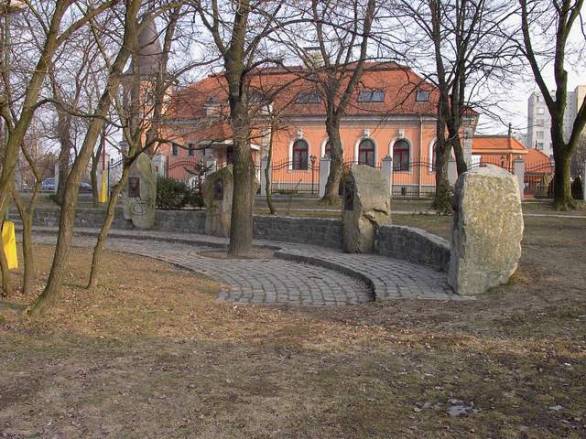
This is the kind of thing I am always curious about. What I expected was plaques of obscure (to me) local figures from the communist era (national-level figures such as Husak or Jakes would probably not have survived past 1990), or perhaps, given the ethnic composition of the region, even figures from 19th century Hungarian history (with signs that these replaced had earlier plaques of Husak and Jakes). What I did not expect were these figures:
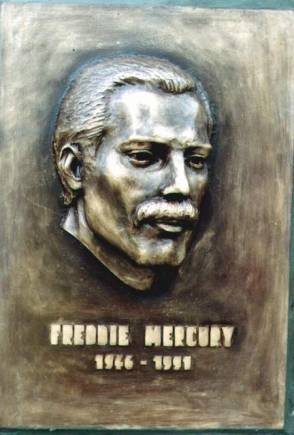
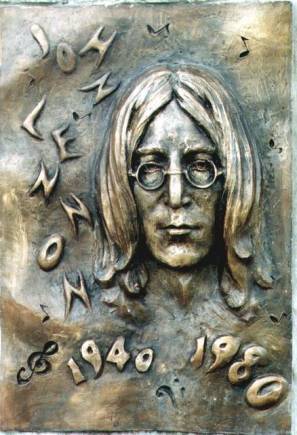
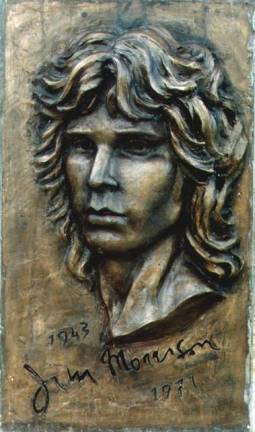
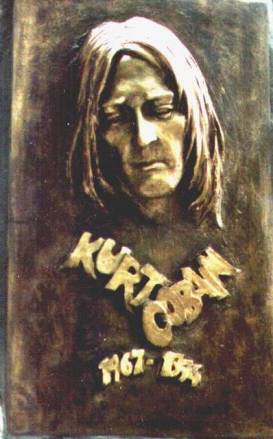
Freddie Mercury, John Lennon, Jim Morrison and Curt Cobain. Not pictured here–because they are unfortunately not yet on the park’s website–are additional plinths dedicated to Jimi Hendrix and Bon Scott. The website explains that the plinths and plaques were erected by a civic group called “Immortal” founded in 1992 to “provide financial aid to anti AIDS and drug publications, moreover we help financially and provide concert opportunities to the beginner local and regional bands.” The Slovak Spectator has a bit more information here.
So having found my surprise, I must wonder what to make of it. As a student of politics, I am paradoxically delighted to see an emphasis on the non-political. While more than a few fights have erupted over musical taste (see below), the choice of rock stars here does not have same potentially divisive character as a set of political representations, and so it is good to see. (It is reminiscent of a comment by a Czech friend who pointed out how much simpler life would had been if local mayors had insisted on streets named after trees and flowers instead of political figures. Between 1918 and 1992 the name of street of my institute in Plzen changed from Franz Josef, to Woodrow Wilson, to Hermann Goering, to Victory, to Stalin, to Moscow, to Svoboda, back to Moscow, and finally to America).
And yet, politics remains an issue, particularly when it involves rival ethnic groups. The same group that built the music park–Immortal–also lists among its activities the creation of a statue of (Hungarian) King Istvan. There is no lack of ethnic symbolism in such a choice and no absence of politics. The issue of ethnicity does not go away, even though members of ethnic communities may sometimes actively focus on uniting rather than dividing. Through the work of Immortal in Samorin, “Imagine” meets “We Are The Champions” in more ways than one.
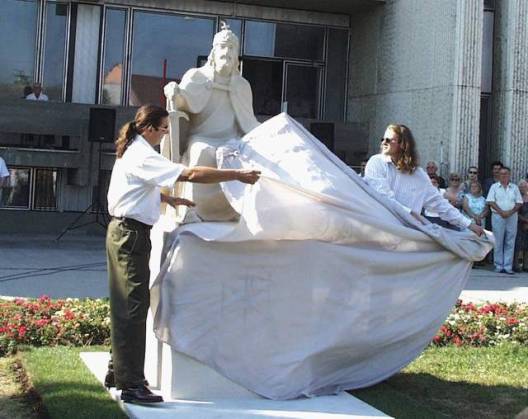
Finally, as a postscript, there is the question of music, about which I have no expertise but lots of opinions. The recent elevation of Bon Scott of AC/DC raises questions about the current direction of the foundation. Its members does not appear to have rejected candidates on the basis of lifestyle or cause of death. The only common denominators appear to be “rock star” and “died young” and so it is rather a shock that Scott precedes Bob Marley and Keith Moon and a variety of others. Unfortunately the current trend points instead toward Jeff Pocaro of Toto and Steve Clark of Def Leppard. Fortunately this may lead at long last to memorials for the deceased drummers of Spinal Tap (if they can find enough room in the park).