Money in Politics

As far as I can tell there are no odds markets like http://www.biz.uiowa.edu/iem/, http://www.intrade.com for Slovakia’s politics, but there are more traditional bookies that sometimes deal in politics.  In 2006 Tipos (http://ekurz.etip.sk) dabbled in parliamentary odds, but did a rather poor job such that straight betting on the poll averages allowed would-be-bettors to make money (http://www.pozorblog.com/?p=18).  Now Nike (http://www2.nike.sk/index.php?cmd=sk/info/clanky/full-section/4480) has entered the fray with a presidential option.  This is probably a no-brainer since the election outcome is unlikely to change from current polls putting Gasparovic ahead, and betting on him at 1.2:1 would probably yield less than the transaction costs.  Still, I’ll try to follow these numbers and see if they change on a daily basis.  Here are the current odds:

Gasparovic, 1.2:1
Radicova, 3.5:1
Martinakova, 100:1
Miklosko, 120:1
Melnik, 800:1
Bollova, 900:1
Sidor: 1000:1

What makes the difference between Melnik’s 800 and Sidor’s 1000 is a curiosity, but I suppose if everybody other than Radicova was 500:1 it wouldn’t seem very interesting for the bettors.

2009 Presidential Election, First week of March

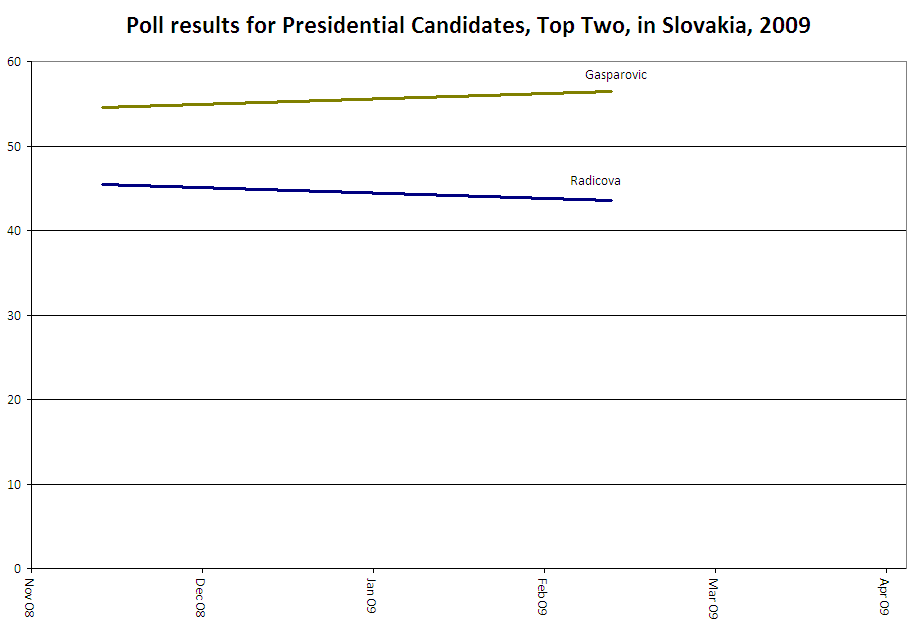
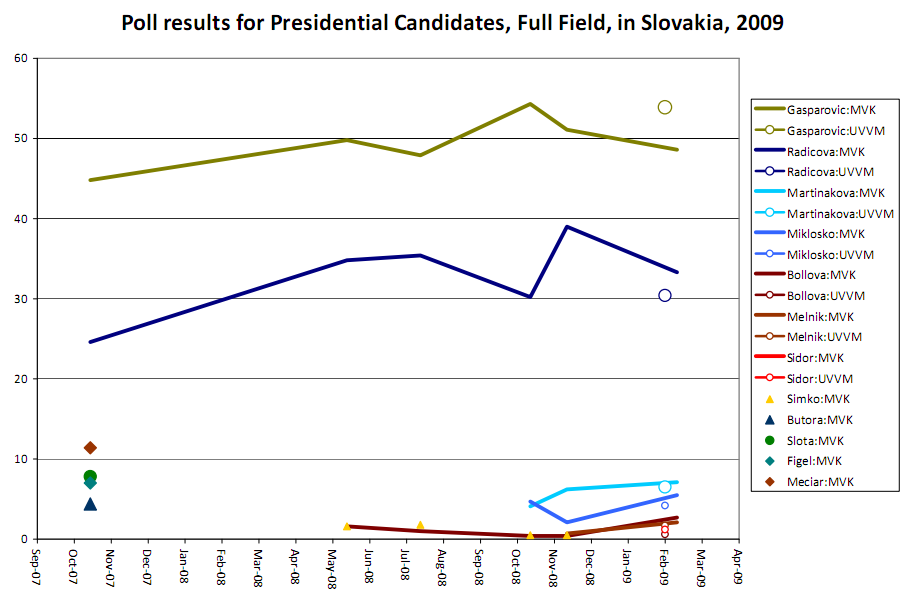
 I should probably post something on the presidential election campaign in Slovakia, though there is not much to say, both because the race has been extremely stable and because I simply have not been able to find much polling.  FOCUS has not yet offered numbers and UVVM only started this month (as far as I can tell) and so we’ve only got irregularly and incompletely reported numbers from MVK.  Still, that is something.  The race as we know it appears below.  Gasparovic has consistently led the field, hovering around 50% in every poll except a very early one in 2007 that included likely competitors from the Slovak national bloc (Meciar and Slota).  Radicova, by contrast has hovered around 35% (except in that first poll at a time when she had less name recognition).  Other candidates have gone and come, but Martinakova of Slobodne Forum appears to have a solid 5% and Miklosko of KDS just a bit less.  At the bottom comes the trio of Bollova (former KSS), Sidor (KSS) and Melnik (HZDS) with 2% or less.

Poll results for Presidential Candidates, Full Field, in Slovakia, 2009

Comparing these candidates with their party results is not always easy or useful but it does lend certain insight into the underlying dynamics of the country’s politics.  Gasparovic has polled 50% when his own former party HZD has languished below 2%. Clearly Gasparovic gains most of his support from Smer and SNS (though he slightly underpolls the combined strength of those two parties).  Gasparovic may also gain some support from voters of his previous former party, HZDS.  This is mitigated to some degree by HZDS chair Vladimir Meciar’s idiosyncratic campaign against Gasparovic, whom he regards as a traitor to his party, but while this campaign may cost Gasparovic some votes, it certainly has not been successful in luring voters to HZDS’s own candidate, Melnik, who stands at 2%, less than a third of HZDS’s 6% (and it shows HZDS’s continued decline).  Bollova and Sidor together attract more votes than KSS, but only by about a half of a percentage point, so it does not seem that these alternatives on the statist left draw many voters away from Gasparovic.

Perhaps the most interesting question is on the right.  The parties of the right (including the Hungarians) consistently poll about 35%, about equal to Radicova’s total, but Radicova likely shares the vote of that bloc with Martinakova and Miklosko who together poll around 10%.  This means that either Radicova or the other two (or all three) pull some voters from uncommitted voters.  Martinakova outpolls her party by about 3-4%) and Miklosko’s party has only about 1% in the polls, so virtually all of his vote comes from partisans of other parties.  It is difficult without the actual data to assess the ebb and flow here, but it would appear that the presidential candidates of the right-wing parties are, by a solid margin, more popular than the parties themselves, and this suggests some room for growth on the right side of the political spectrum (but only if those parties were to seek out new leadership, something that KDH and SMK–but not SDKU–may currently be thinking about).

The potential gain becomes most obvious in those polls that pit Gasparovic directly against Radicova.  In these, surveys (of which we have only two, both conducted by MVK) Radicova draws closer to Gasparovic, gaining an average of 8% compared to Gasparovic’s gain of 5%.  This is to be expected since the candidates closer to Radicova (Martinakova and Miklosko) have more support than those closer to Gasparovic (Bollova, Sidor, Melnik), but it is still noteworthy since it suggests that a moderately charismatic candidate of the right can gain significantly larger numbers of voters than do the parties of the right.

Poll results for Presidential Candidates, Top Two, in Slovakia, 2009

January 2009: FOCUS echos UVVM

January 2009 poll comparisions and averages

I should have known to wait for the FOCUS numbers to come in before writing yesterday’s post.  FOCUS is coming in much more quickly these days.  This month, however, one or the other would have been enough as the results are strikingly similar.  The two polls show the same trends for every major party.
For Smer the two moved in the same direction, almost perfectly.  Gone may be the day when FOCUS was much lower than UVVM on numbers for Smer.  Whether this is the result of a shift in network, methodology or the end of a long string of chance differences, I cannot say.  (Anyone know the answer?).  This month showed a decline from a peak in both.

Multiple-poll+average+ for +Smer+ for the most recent +4+months+ in Slovakia

For SDKU the resultsof the two polls have been shockingly close for three months now.  SDKU has stabilized, perhaps helped a bit by Radicova’s presidential campaign (perhaps not).

Multiple-poll+average+ for +SDKU+ for the most recent +4+months+ in Slovakia

This graph of recent results for SNS shows a fairly wide divergence but similar trending–very slowly downward since December.

Multiple-poll+average+ for +SNS+ for the most recent +4+months+ in Slovakia

This graph of recent results for MK shows a slight rise in both polls, though the 2% gap is wide for such a small party.

Multiple-poll+average+ for +MK+ for the most recent +4+months+ in Slovakia

The two polls’ numbers for HZDS are (as they have been) incredibly similar.  HZDS has reached its lowest recorded numbers in both polls (though with FOCUS this represents a tie with its numbers from August 2008).

Multiple-poll+average+ for +HZDS+ for the most recent +4+months+ in Slovakia

This results for KDH show greater similarity between polls than during much of last year.  Both polls have shown essentially identical results for January and February and this time it is good news for KDH which has risen in both, even after its vice-chair Daniel Lipsic raised a storm by talking about his party’s participation in the “buying” of deputies during the previous parliamentary term.

Multiple-poll+average+ for +KDH+ for the most recent +4+months+ in Slovakia

This graph of recent results for KSS shows little change from last month with the two polls placing the party in its traditional zone between 2 and 3%.

Multiple-poll+average+ for +KSS+ for the most recent +4+months+ in Slovakia

This graph of recent results for SF shows a small gain in both surveys moving it toward 3%, up notably from its nadir a year ago at less than 1%.  The party’s gains have been steady, so it is difficult to attribute this solely to the increased visibility due to party chair Martinakova’s presidential bid, but this may help.

Multiple-poll+average+ for +SF+ for the most recent +4+months+ in Slovakia

The two other oft-polled parties, remain insignificant.  ANO broke 1% for the first time in 5 months in the FOCUS poll but was nearer to zero in the UVVM poll; after some respectable (for it) showings around 2% in the past months, HZD is back at around 1% in both polls.

Finally, FOCUS has decided to continue with its addition of small parties–KDS, ZS and LIGA.  Each of these parties did better than in the previous month of polling by FOCUS: ZS rose from 0.4% to 1.0%, almost identical to its 1.1% result in UVVM polls.  KDS rose from 0.3% to 0.6% (at the same time that KDH rose several points) in the FOCUS poll.  LIGA rose from 0.3% to 0.4%.  So far SaS is present on the polling list only of MVK and we do not have MVK numbers for January or February.

Since the two polls showed such similar results, averaged all together it is almost indistinguishable from yesterday’s report on UVVM.  Smer leads, SDKU stays stable, SNS and HZDS drop slightly, KDH and SMK rise.

2:||||||||||||||||||||||||

UVVM+poll+data+ for +all+parties+except+Smer+ for the most recent +4+months+ in Slovakia

This means that the coalition stops its climb and the opposition stops its fall and so we are back almost exactly to mid-2008, though with HZDS a bit weaker and Smer a bit stronger.

Multiple-poll+average+ for +coalition+support for the most recent +24+months+ in Slovakia

The only really noteworthy result of analysis by bloc is that the “Slovak National” bloc falls to its lowest recorded levels (around 18%).  I doubt that these voters have lost their national sentiment, but they may have shifted to KSS or Smer (or even KDS?) which are not exclusively nationally oriented.

Multiple-poll+average+ for +party+blocs+ for the most recent +24+months+ in Slovakia

This month’s distribution of parliamentary seats shows that this all makes little difference so far in the big picture.  As always, Smer can form a government with only one partner (and since the numbers putting Smer with a simple majority last month were unlikely to be reached in an actual election, this is the way it has been essentially since the 2006 election.)Multiple-poll+average+ for +estimated+party+seat+distribution for the most recent +1+month+ in Slovakia

Multiple-poll+average+ for +estimated+party+seat+distribution for the most recent +24+months+ in Slovakia

As always, the actual polling numbers are available online at Google Docs:
http://spreadsheets.google.com/pub?key=pdhlCClsiyAMi39bLFpY_Zg

And the most recent three months are below in tabular format (using “iframe” which may not work on all browsers).

<br />
February 2008 UVVM: Coalition down slightly, new counting method for UVVM

UVVM Monthly Report for December 2008

If you set your frame narrowly enough, things can change quickly. In the big picture, nothing much has changed since last month, and the relative positions of parties are pretty much as they have been for the last two years.  Within that narrow frame, however, the current coalition has gone from near-highs for the post election period to near-lows thanks to drops in all three of the coalition parties, the first time all three have dropped simultaneously since late 2006.

Of the three, Smer’s drop was the largest but by far the smallest in percentage terms and the drop occurred after one of the party’s near-high scores, so some correction may be expected.  This month’s 46% is still one of the party’s eight highest scores over the last 30 months.
UVVM+poll+data+ for +all+parties+ for the most recent +24+months+ in Slovakia
UVVM+poll+data+ for +all+parties+except+Smer+ for the most recent +4+months+ in Slovakia

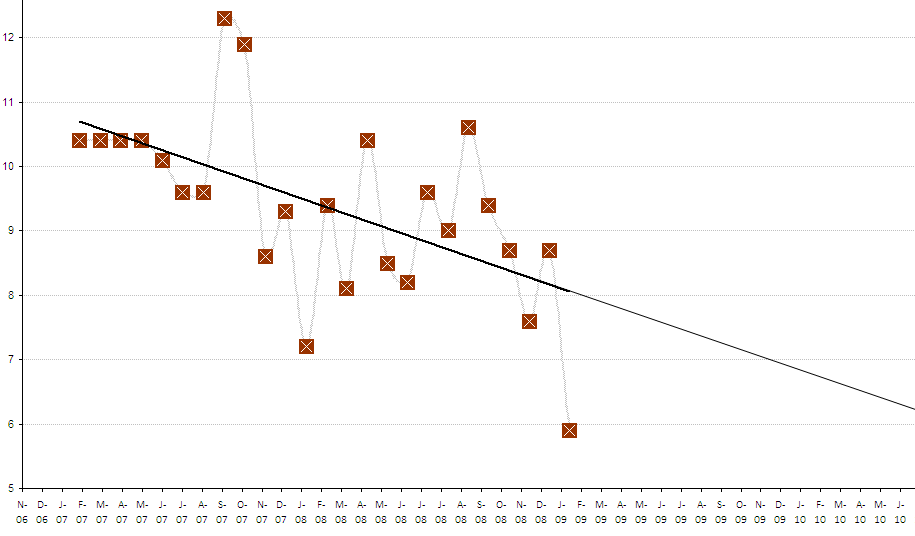
For the other coalition parties, the drop was more significant, with SNS sliding back toward the 11% mark after a high point late in 2008 and HZDS dropping to its lowest mark ever recorded in a major survey, the first time the party has ever received less than 6%.  Of course there is a lot of noise with smaller parties, but HZDS’s tendency to hit new lows every six months or so and its inability for its occasional highs to rise to the levels of previous highs cannot be happy news within the party.  The graph below suggests that the party is not yet in danger of dropping below the 5% threshold in the 2010 election, but the danger is getting closer, particularly since party regularly varies more than 1% from its trendline average meaning that with current trends there is a strong chance that the party will post at least one or two results below the 5% threshold in the months just before elections, a symbolic result that could further hurt the party’s chances.

HZDS trendline

For the opposition parties in parliament, this was a good month, especially for KDH which seemed to be facing a slide as serious as that of HZDS. Again there is a lot of noise and variation here but this gives the party a brief reprieve.  Overall, as the graph below shows, the opposition parties are back near their high point for the post election period.  Unfortunately for them, this is a paltry 33%.

UVVM+poll+data+ for +coalition+support for the most recent +24+months+ in Slovakia
UVVM+poll+data+ for +party+'blocs'+ for the most recent +24+months+ in Slovakia

And unfortunately for them, Smer is still within striking range of a one-party government.
UVVM+poll+data+ for +estimated+party+seat+distribution for the most recent +1+month+ in Slovakia

UVVM+poll+data+ for +estimated+party+seat+distribution for the most recent +24+months+ in Slovakia

As always, the actual polling numbers are available online at Google Docs:
http://spreadsheets.google.com/pub?key=pdhlCClsiyAMi39bLFpY_Zg
  And the most recent three months are at the bottom in tabular format (using “iframe” which may not work on all browsers).

It is worth noting here, however that UVVM has changed its method for asking about voter participation and that this can have effects on the overall results.  As the table below shows, UVVM has changed its question three times in the last two years, switching to a “Do not sympathize with any” response after the 2006 election and then in 2007 changing back to the method it used before which allows a “will not vote” response.  This new option lowered the number of people who specified a party from an average 0f 74% to an average of 68% (though increasing disillusionment with all parties could explain some of the decline).  Now UVVM has split the question into two parts, first asking whether respondents will vote at all and then asking whether for whom they will vote. Asking first about voting has the immediate effect of increasing the share of “will not vote” responses by 8 percentage points.  In the second phase, the survey asks those who will vote to specify a party and here too it allows a “do not know” response.  Between the 8 point increase in “will not vote” and the 3 point increase in the combined “do not know” (respondents who do not know if they will vote and those who do not know for whom they will vote), this method produces an 11 point drop in those who actually specify a party.  Whether this is good or bad is hard to say.  It suggests a lower level of turnout–and I suspect the purpose of the shift is to fix UVVM’s overprediction of turnout in 2006–but whether it is a more accurate measure of results is hard to say.  It is notable that it does not substantially alter the overall party preferences, all of which stay within a few percentage points of their numbers using the old method.  Of course the only way to really test the effect is to ask both sets of questions at the same time, but this would double the expense.  More news on this as I find out any details.

2006 2007-2008 2009
For whom will you vote? For whom will you vote? Will you vote? For those answering “Will vote”: For whom will
you vote?
Does not sympatize with any 26.4          
    Will not vote 17.9 Will not vote 25.0
Does not know who to vote for 14.2    
    Does not know whether to vote 11.4
Will vote 63.6
Specifies party 73.6 Specifies party 67.9   Does not know whom to vote for 6.2
Specifies party 57.4

Finally, I should note that like MVK and FOCUS, UVVM appears to have added the Party of Greens (SZ) to its list of parties on the official roster.  At some point I will rework my software to include them here, but for the moment they remain at a single percentage point (close to the results obtained by FOCUS in January) and so not much is lost by their omission.  It is noteworthy that only one in a thousand respondents (here it can only be one out of the 600 asked) specified a party not on the list, suggesting that there is no spontaneous support for KDS, Liga, or SaS.

<br />

January 2009 Poll Averages: Smer gains, KDH loses, new parties become visible

January 2009 Poll Averages

Overall Monthly Report

Numbers for January are in and while there is not too much to report, there are a few striking findings.  Smer had an excellent month, tying its previous high score in UVVM and achieving a new high in FOCUS (by more than 2 percentage points over its previous high in October 2008).  As the graphs below show, this means that for the first time the poll /average/ gives it a straightforward parliamentary majority of 76 seats.  The big open question is whether a sinking economy will pull these numbers down, but every time it seems that the party has now hit its peak, it sags a bit and goes on to a new peak, so this is truly an open question.

2:||||||||||||||||||||||||

This short-term graph of poll results for averages of major parties other than Smer shows a sharp–two percentage point–drop in KDH not quite compensated for by a rise in SDKU, while within the coalition, SNS’s loss was HZDS’s gain (perhaps literally).  And SMK continues its slow slide to places well below its demographic base.  In general the nationali parties have remained stable while the major opposition parties have all dropped by small margins over the past few months. Among the smaller parties, KSS stayed stable and the 4% result for Slobodne Forum in last month’s FOCUS poll is even more clearly apparent as an outlier.  HZD (not shown here) has been on a very slight upward trend, perhaps related to the Gasparovic presidential campaign, but shows nothing like the bounce that it saw in Gasparovic’s previous campaign.

UVVM+poll+data+ for +all+parties+except+Smer+ for the most recent +4+months+ in Slovakia

Not pictured here–because they are mere single data points, is new polling data for other small parties, many themselves new. FOCUS has apparently begun to follow the lead of MVK and include these parties on their response sheet, making it easier for voters to choose them.  The psychological effect of this choice is immediately apparent, increasing by a factor of 10 the number of people specifying a party other than those above (albeit from 0.1% to 1.0%).  The Party of Greens (SZ) netted 0.4% from this choice while the KDH-splinter Conservative Democratic Party (KDS) emerged at 0.3% and the liberal LIGA emerged at 0.3% as well.  The 0.3% for KDS may have some bearing on the drop in KDH, but the 0.3% represents only one seventh of the KDH decline.

It is notable that FOCUS numbers for these small parties are much lower than those of MVK which regularly reports SZ figures above 2% and in September reported KDS at 0.8% (but has not reported KDS numbers since).  Interestingly MVK in December put the numbers of yet another new party, the liberal Freedom and Solidarity (SAS) at 2.0%.  FOCUS did not include this party in its list.

Now back to results for bigger parties. Even with weakness in SNS, the Smer increase (and small HZDS increase as well) still pulls the coalition to a new high of 66%: two out of three voters in Slovakia.

Multiple-poll+average+ for +coalition+support for the most recent +24+months+ in Slovakia

This long-term graph of poll results for (loosely defined) party “blocs” parties shows the coalition’s increase coming from Smer while SNS and HZDS continue to split their 20%, each month differing only in who gets how much of it. The drop in KDH hurts the opposition significantly.

Multiple-poll+average+ for +party+blocs+ for the most recent +24+months+ in Slovakia

This month’s distribution of parliamentary seats shows the first “poll average” Smer majority.  It’s coalition partners bring an additional 29 seats.  The opposition by this standard would muster 45, which is not that much more than the current coalition without the Smer majority.Multiple-poll+average+ for +estimated+party+seat+distribution for the most recent +1+month+ in Slovakia

Multiple-poll+average+ for +estimated+party+seat+distribution for the most recent +24+months+ in Slovakia

As always, the actual polling numbers are available online at Google Docs:
http://spreadsheets.google.com/pub?key=pdhlCClsiyAMi39bLFpY_Zg

And the most recent three months are below in tabular format (using “iframe” which may not work on all browsers).

<br />
Elected Affinities in the Cloud

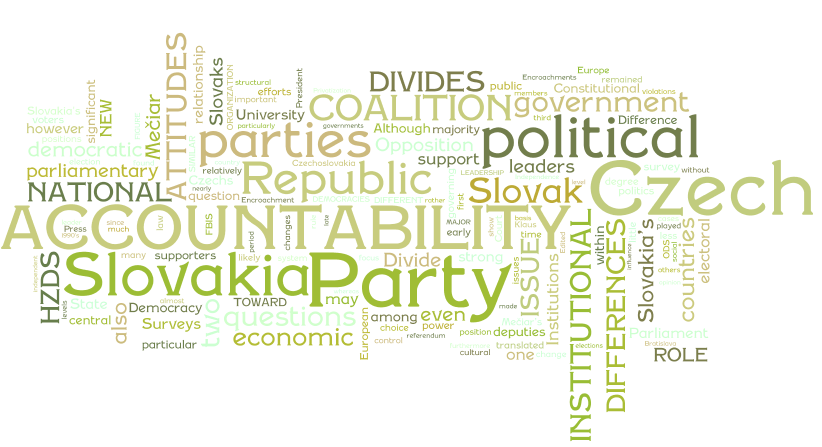
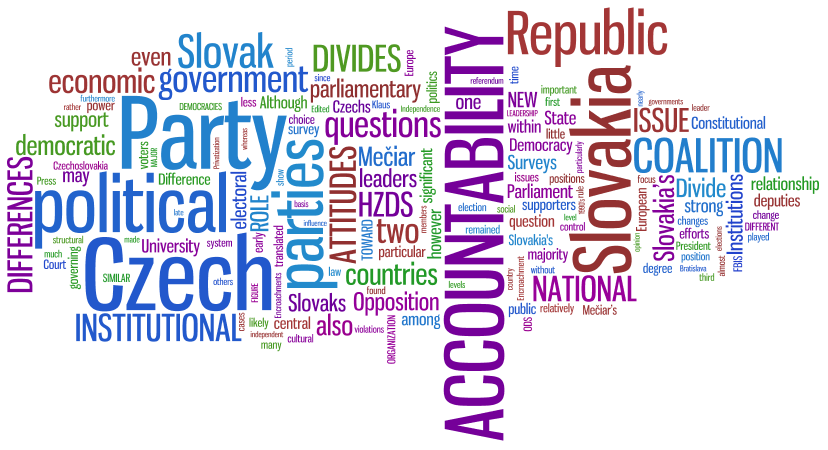
The first blog I ever read on a regular basis was BldgBlog and I still read every word, so when it posted a word cloud of the upcoming BldgBlog book made on wordle.net , I felt obliged to try it with my own book. The results are gratifying:

Elected Affinities

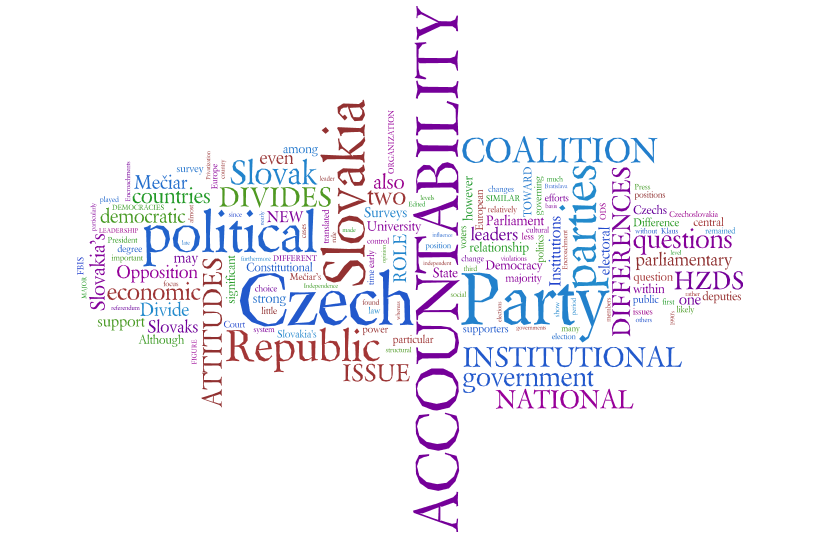
Not only does it look a bit like Slovakia and/or the Czech Republic, but it really does contain all the ideas I cared about when I was writing it (and care about still).  And it helps me think about the idea of machine-based content analysis.  While this counting words does not say much about what I think, it does accurately capture what I am thinking about.  (See here for other ways to determine what I am thinking about; see below for wordles with different font and color schemes).

Elected AffinitiesElected Affinities

Obama in SME

Obama in Sme

After months in Slovakia hearing reasons why Americans would not vote for Barack Obama for President (including some from Americans) the question is how President Barack Obama will relate to Slovakia. On Monday I received a series of excellent questions from SME.  Since space considerations dictated the publication of responses to only the most immediately interesting–see  http://www.sme.sk/c/4270545/bratislava-nebude-obamovo-mesto.html (I am still waiting for the day when articles in Slovakia’s newspapers regularly exceed the 500-word mark, something that should be possible in the internet era)– and since I would hate to let my 10 minutes of top-of-the-head responses go unpublished, I post below both the questions and my answers.

Why is America and American president important for Slovakia? Which American presidents can we consider as very important for Slovakia and Slovak nation?

As the world’s largest economy and largest military the United States has an almost unavoidable efect on every country.  It is unlikely that the new administration will have much practical significance for most citizens of Slovakia, but in symbolic terms this inauguration is one of the most important in the past century, and the excitement among Americans—particularly the college-age students I teach—is unprecedented in my lifetime.  Among those American presidents who have had a deep influence on Slovakia’s development it is difficult to name any except Wilson, who aided the creation of Czechoslovakia, and Roosevelt who pursued a successful course in the Second World War.  Some might cite Reagan, but scholarship suggests that his effect on the collapse of the Soviet Union was marginal at best—a matter of timing rather than outcome.

Let’s look back to the history of Slovak-American relations – how do you see its development from 1993 independent Slovakia until now? What were the turning points?

The turning points in US-Slovakia relations are really the same as the turning points in Slovakia’s own politics.  Relationships between the Clinton administration and the successive Meciar governments cooled very quickly and remained quite cold during the 1990’s, though I never got the sense of any animosity toward Slovakia itself.  The defeat of the HZDS government in 1998 improved relations, both because the new government seemed more firmly committeed to democracy and stability in the region which helped aussuage the long-term concerns of the State Department.  The new government then ingratiated itself further through active cooperation with the Bush administration‘s foreign policy goals, even to the extent of supporting the war in Iraq. Under Fico the government has pulled back from this active cooperation and has offered some sharp criticisms, but it is not clear to me whether this has translated into a relationship that is more conflictual at the operational level, and it is notable that the US has moved ahead with the process of reducing or eliminating visa requrements.

May we expect Obama’s visit to Slovakia or Europe in the next years? When and why?

Unfortunately, I would not expect a visit.  I suspect that Obama’s main goals in the first few years will be domestic and that when he does travel abroad he will work on improving relations with countries where the Bush Administration’s policies did the most damage.  Slovakia is far down that (rather long) list.  I’m afraid, too, that the prominence of the Bush-Putin summit in the relatively recent past will move Slovakia further down the list.  Unless there are compelling reasons, countries that win one of these big events tend to move to the bottom of the list and cycle back to the top very slowly

Don’t you think European countries and leaders are expecting too much from Obama in sense of  „monumental change“ in mutual relations and US foreign policy?

I think almost everybody (except maybe Sarah Palin) is expecting too much from Obama.  I think his policy will certainly differ from that of the Bush Administration, but that administration’s policy stood near the extreme of unilaterialism.  Obama will not transform American diplomacy, and he will not radically reshape relationships with adversaries or allies, but he will bring it back toward the norm under Bill Clinton (and this is no surprise given that Hillary Clinton will be the Secretary of State).  The US under Obama promises to be a country that will make strong efforts at multilaterialism but that will still act unilaterally if it feels that its interests will be otherwise threatened. 

Our last government presented itself more in the light of euro-atlantic cooperation, current government is more ambiguous.  May this play a role in mutual relations in sense of change of American position towards Slovakia after Obama is inaugurated?

I will be interested to see whether the Fico government changes its relationship once the United States has a government closer to the economic left and more prone toward multilateralism.  My sense is that foreign policy stances and foreign policy rhetoric in Slovakia have been driven largely by domestic political considerations.  I do not know whether the relatively more left-of-center positions of the Obama presidency will change those considerations and shift the positions or rhetoric of the Fico government.

December 2008: Final Poll Comparisons

The always unpredictable MVK has come in with new numbers for mid-December and so it is briefly worth revisiting the graphs.  The most interesting news from this survey, however, are the results for small parties that I do not cover here and will try to address in the next post.

As we knew from the other polls, the big November drop for Smer was more likely a sampling artifact rather than a genuine drop.  This month Smer returns to 39% where it usually polls with MVK.  This is lower than averages for other pollsters for 2008–2 points lower than the FOCUS average of 41 and 6 points lower than the UVVM average of 45% for the year.  One reason for that may be MVK’s inclusion of a larger number of smaller parties on its questionaire and the resulting loss 2-4% of Smer support to those who might otherwise pick Smer but who, when presented with an option such as “Green Party,” opt for that one.  As UVVM and FOCUS results suggest, almost nobody in Slovakia actively mentions the Green Party when asked an open question, but when given the option, a few percent move in that direction which, coupled with lower numbers for Smer on such polls, suggests a limited softness in the party’s support (which is no surprise anyway).

Multiple-poll+average+ for +Smer+ for the most recent +4+months+ in Slovakia

This graph of recent polling results for SDKU show strong agreement and again suggest that November’s MVK poll had some sampling problems.  All December polls show SDKU between 11% and 12%.

Multiple-poll+average+ for +SDKU+ for the most recent +4+months+ in Slovakia

December results for SNS produced an unexpectedly wide range of results, especially for a party that had produced near consensus in previous month.  MVK results suggest that this was a sampling issue, with results that bisect the FOCUS low and the UVVM high and keep the party’s average almost unchanged from the previous month.  Ethnic controversy, by this standard, does not seem to be a major electoral boost for the party.

Multiple-poll+average+ for +SNS+ for the most recent +4+months+ in Slovakia

This graph of recent results for MK shows much the same, with an extremely narrow distribution at 8%.  This is low for a party with a demographic base of over 10% and for one facing the sort of political challenges that usually rally ethnic populations ’round the party.

Multiple-poll+average+ for +MK+ for the most recent +4+months+ in Slovakia

This graph of recent results for HZDS showsthe continuing slow slide.  The party is at near record low levels in 2 of  3 major surveys and at its second lowest overall average in its history.

Multiple-poll+average+ for +HZDS+ for the most recent +4+months+ in Slovakia

This graph of recent results for KDH shows a rise in December and MVK exactly bisects the two other polls, as it often does.

Multiple-poll+average+ for +KDH+ for the most recent +4+months+ in Slovakia

This graph of recent results for KSS shows now real change, but MVK numbers for Decembers show a slight drop from their periodic high in November.

Multiple-poll+average+ for +KSS+ for the most recent +4+months+ in Slovakia

This graph of recent results for SF shows suggest caution about notions of an SF boomlet found by FOCUS.  I cannot find SF numbers for the November but the party’s numbers have not changed measurably from the most recent poll number I have for September.  This, combined with unchanged numbers from UVVM offer reasons for skepticism.  It may be, however, that what might otherwise have been an SF rise in December was affected negatively by the inclusion of yet another new party–Sloboda a solidarita–designed to appeal to the same demographic.  But about SAS more in the next post.

Multiple-poll+average+ for +SF+ for the most recent +4+months+ in Slovakia

Chickens, roosting

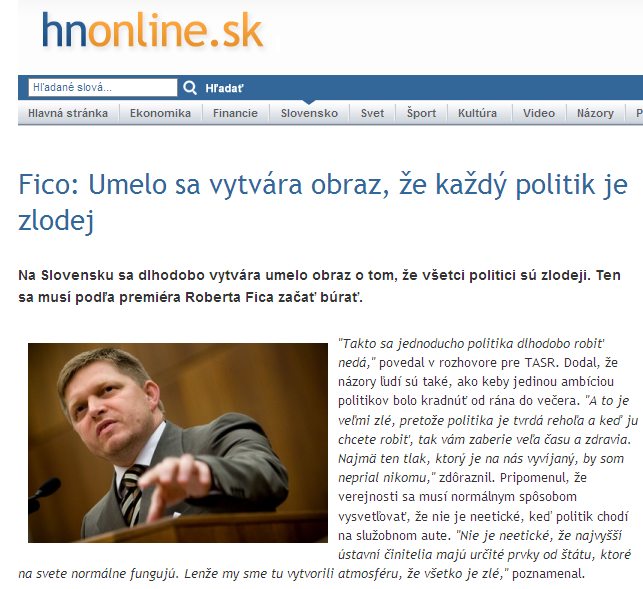
I was intrigued to see stories about a recent Fico appearance, particularly one in HNOnline entitled, “Fico: There is an artificially created impression that every politician is a thief.”

Fico: They have artificially created the impression that every politician is a thief

How did that impression get created?  I have a partial theory:

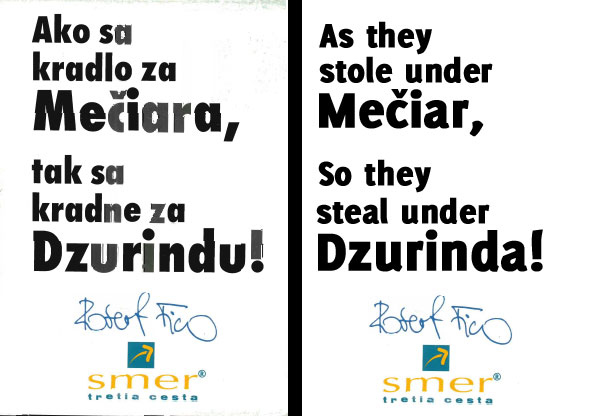
As they stole

The points Fico raises in the article are not at all inappropriate:  Politics is hard work and the “perks” of politics in many cases only amount to an amelioration of difficult working conditions (being a good politician–as Fico is–is probably easier than working in a mine, but the hours are long and the demands and stresses are extremely high).  As a political figure who does not appear to be using the office for personal financial gain, Fico must be particularly incensed.  Yet he did not shy away from such attacks while he was attempting to gain power and he must bear some of the responsibility for his own difficult circumstances.

The broader issue here is the question of corruption in the electoral politics of postcommunist countries (and elsewhere as well).  When corruption levels are high (or are perceived as high), corruption becomes an issue in itself and becomes for ambitious politicians to gain support (especially ambitious politicians who have not engaged in obvious corruption themselves).  This is often a pyrrhic victory, however, since success puts those same leaders in the sights of their own weapons: even if they stay clean, their associates may succumb to the temptation, and even if they do not, it is often difficult to persuade voters that the new boss is any different from the old boss, especially when they ride around in the same dark, powerful sedans.  And it is not suprising that Fico, even at the top of his electoral game, feels pressure from precisely the sense of cynicism toward elected officials that he participated in creating, the same sense that allegedly produced somebody to amend the above-mentioned Fico billboard to read “…and so they will also steal under me”

For more on the famous (in Slovakia) Fico advertisement, see:

For more on the dynamics of anti-corruption campaining, see: