Euroblindness II: Curse of the Habsburgs?

Eurovision voting 2009

I could not bring myself to watch last night’s semi-finals of the Eurovision Song Contest (the finals will be enough, thank you) but I was amused to find this morning that virtually my entire region of study was wiped out in the voting over the last several days.  Thanks to a Wikipedia map (wow, that was fast) it’s graphically apparent that not one country from the Visegrad 4 made it past the semifinals.  Slovenia also didn’t make it and Austria (on the map in non-participant yellow) didn’t even bother.  The only other Euroregion to be similarly shut out was Benelux.

As a social scientists, I must ask why? The Danube appears to have something to do with this, and already yesterday Pravda prepared Slovaks for their unfair defeat by pointing out the non-musical charms of semi-final rivals and the academic qualifications of Slovakia’s participants.  But I’m putting my money on a different causal factor:

Mozart's travels in Europe

Past visits by Mozart (see above) appear to inoculate a country against selection to the Eurovision finals (Germany, France and England have automatic bids) and in some cases (Luxemburg, Italy, Austria, even from desire to enter.

Regardless of the causal factors, this spares everybody the awkwardness of having Slovakia’s 12 points go to Hungary and for that everybody can be grateful, except maybe Jan Slota of the Slovak National Party (who could use a national distraction from other troubles).

April 2009 Final Poll Comparisons

There is an old Communist-era joke in which one character asks the other, “Why weren’t you at the last party meeting?” and the other responds “If I had known it was the last party meeting, not only would I have shown up but I would have brought a bottle of champagne.”  In a similar–if more unfortunate vein–when I talk about the last UVVM survey of public opinion in Slovakia, I mean the last one.  The Statistical Office of the Slovak Republic has stopped the monthly public opinion polling on parties that gave Slovakia one of the most robust public-opinion tracking data of any country in postcommunist Europe.  The office has been discussing this for over a year (the director of the office, Ludmilla Benkovicova, discussed this with me in an interview in June 2008 and it was in the air well before then) but it is awkward for all concerned that the polling ceased precisely at a point when, according to a report by Pravda (http://spravy.pravda.sk/hzds-a-sns-nepadli-popularitu-straca-len-smer-faz-/sk_domace.asp?c=A090425_120119_sk_domace_p23) the ruling party, Smer, allegedly received its lowest support in over a year-and-a-half, and the ruling coalition allegedly received its lowest support since the June 2006 election.  I write “allegedly” because in addition to ending the party preference polls, the Statistical Office also embargoed the results of April poll that included those numbers and we have them in the public realm only because Pravda claims to have obtained a copy (which it also claims that Benkovicova did not deny).

It is hard to know what to make of Benkovicova’s decision since she cites an EU directive with which I am not familiar and since it is possible to make a good argument against government sponsored polls as the centerpiece of a country’s polling infrastructure.  At the same time, UVVM has done excellent work and has seemingly remained immune from political pressure.  Furthermore, while the circumstances and motives of the current decision might be entirely different, it is also worth noting that the last time UVVM stopped public release of polling information on political parties, it was during the government of Vladimir Meciar.  The polls came back after Meciar left.  We shall see if they do so again after Fico’s departure.

Because of the informal nature of the release of the UVVM April data, we only have a partial range of figures (none of the smaller parties or the share of non-voters) but fortunately we also have numbers from FOCUS for the most recent three months.  There are also numbers from the firm Median but I am hesitant to put these into the broader model as they lack the track record of the others.  I will try to do some more analysis of Median numbers and see over the next few month whether these are worthy of inclusion.

So what do we find. The graph averaging the last 24 months of polling results from multiple sources shows a drop for Smer back to the plateau it reached during the final months of 2008, the first time since the 2006 election that Smer has seen three consecutive months of drop.

2:||||||||||||||||||||||||Multiple-poll+average+ for +all+parties+ for the most recent +4+months+ in Slovakia

The drop comes off a record high, however, and so the news is not terrible, especially since while UVVM numbers showed a big drop (to 40%), FOCUS numbers showed the party increasing slightly.

Multiple-poll+average+ for +Smer+ for the most recent +4+months+ in Slovakia

This graph averaging the last 4 months of polling results from multiple sources shows this in more detail and suggests a minor shift in the overall dynamics of party competition.  Whereas originally there had been 4 groups of parties (Smer on its own above 40, SDKU and SNS between 10 and 15, HZDS, KDH and SMK between 5 and 10 and then a group of parties under 3, there are now 4 different groups (Smer alone, still above 40, SDKU in clear second above 15, SNS, KDH and SMK between 5 and 10 and parties under 3.

UVVM+poll+data+ for +all+parties+except+Smer+ for the most recent +4+months+ in Slovakia

This graph of recent polling results for SDKU shows a strong recovery–some of the highest poll numbers SDKU has ever had–perhaps because of the relatively strong performance by its presidential candidate, Iveta Radicova–but this bump may not long survive Radicova’s return to relative obscurity.

Multiple-poll+average+ for +SDKU+ for the most recent +4+months+ in Slovakia

This graph of recent results for SNS shows a consistent, slow drop even before the most recent ministerial scandals.  I am curious whether the apparently high levels of clientelism within the party can dislodge even its most passionately anti-Hungarian voters.

Multiple-poll+average+ for +SNS+ for the most recent +4+months+ in Slovakia

The wildcard here is HZDS.  In a February blog entry, I wrote that

“there is a strong chance that the party will post at least one or two results below the 5% threshold in the months just before elections, a symbolic result that could further hurt the party’s chances.”

That moment came sooner than I expected, at least in FOCUS surveys and so significant was the drop that I had to change the scale of the HZDS graph.

Multiple-poll+average+ for +HZDS+ for the most recent +4+months+ in Slovakia

HZDS has a strong cadre of loyal voters–stronger than most other parties of similar or even larger size, but at present the party’s slide is accelerating rather than slowing.  The current numbers put HZDS soon in the under 3% group.  The best case scenario for the party is somehow to hang on near the bottom of the 5%-10% group.
In broader terms these changes suggest a small closure of the gap between opposition and coalition parties, but the gap is still almost as large as the percentage of the opposition parties themselves.  It would take a lot to close the gap completely though of course “a lot” is what the current world economic crisis threatens to deliver.

Multiple-poll+average+ for +coalition+support for the most recent +24+months+ in Slovakia

The long-term graph of poll results for (loosely defined) party “blocs” parties shows parallel declines in the “left” and “Slovak national” blocs of parties and some aims for the opposition “right” bloc, but this again is not nearly enough for a change of government.

Multiple-poll+average+ for +party+blocs+ for the most recent +24+months+ in Slovakia

This month’s distribution of parliamentary seats shows Smer still in a position to form a one-party government with any partner, though its most likely partner, the Slovak National Party, is the one which has seen the dismissal of two ministers and a variety of other criticisms in a short period (though a variety of Slovak analysists suggest that the party needs its government posts (and the wealth to which they give access) too much to complain (http://spravy.pravda.sk/koalicia-vydrzi-sns-potrebuje-zostat-vo-vlade-zhoduju-sa-analytici-1pv-/sk_domace.asp?c=A090505_170429_sk_domace_p23)

Multiple-poll+average+ for +estimated+party+seat+distribution for the most recent +1+month+ in Slovakia

Multiple-poll+average+ for +estimated+party+seat+distribution for the most recent +24+months+ in Slovakia

And finally, because they did not fit into the narrative above (if such a disjointed string can be described as a narrative), a few other specific poll numbers.

The graph of recent results for MK shows stability and a degree of convergence among polls at around 8.5%.  The surveys were taken before Bela Bugar left the party’s parliamentary delegation, however, so we shall see over the next two months whether that has any effect.  We shall see over the next year whether we have a full split on our hands here.  If so, the normally solid representation of Hungarian parties in parliament may come under threat.

Multiple-poll+average+ for +MK+ for the most recent +4+months+ in Slovakia

This graph of recent results for KDH shows convergence as well with little change in average over time.  This is the one party to which nothing has happened over the last several months so the stasis is not unexpected.Multiple-poll+average+ for +KDH+ for the most recent +4+months+ in Slovakia

The graph of recent results for KSS shows a drop, particularly noteworthy since FOCUS numbers which usually put the party around 2% put it here under 1% for the first time in about a year.

Multiple-poll+average+ for +KSS+ for the most recent +4+months+ in Slovakia

Finally the graph of recent results for SF shows a steady rise.  Whether this party is a contender for 2010 (I predict that some pro-market social liberal rival to SDKU will flirt with the threshold in the months before the next parliamentary election but I don’t know that it will be SF, though that party has a better chance than some.  It has something of an organization and some name recognition, while neither Liga nor SaS appears to have yet found legs, but there may be another contender out there somewhere as well.

Multiple-poll+average+ for +SF+ for the most recent +4+months+ in Slovakia

FOCUS numbers show a stable 1.1% or so for the Green party (ZS) in the last two month, and really low numbers (between 0.1% and 0.5% for Liga and KDS.  OKS actually appeared above 0.0% for the first time in years (perhaps because FOCUS is asking about it now), and its emergence significantly undercut KDS (if anything can be called significant under 1% or understood as anything other than random noise.)

As always, the actual polling numbers are available online at Google Docs:
http://spreadsheets.google.com/pub?key=pdhlCClsiyAMi39bLFpY_Zg

And the most recent three months are below in tabular format (using “iframe” which may not work on all browsers).

<br />

Euroblindness

Serifovic

It is nice to see that my rather painful obsession with the Eurovision Song Contest (other people’s tragedies are always more palatable) has some relevance for my profession:

eurovision.png

Nice to see, too, that Slovakia will finally have an entry so that I can see who likes the Slovaks (and watch the excitement as Slovakia’s Hungarian minority votes the whole country’s 12 points for the Hungarian entry (on the odd chance that the Hungarian makes it to the final round): http://www.eurovision.tv/page/news?id=1989

Slovakia’s Presidential Election, Second Round

I have no time to day to do much analysis except to say that the weekend’s 55.5% to 45.5% is closer than I expected a year ago or even several months ago.  It means, in effect, at least 15% of the voters of the current coalition (Smer, SNS, HZDS) and opponents of the previous coalition (KSS and HZD) crossed the aisle and voted for a candidate from the previous coalition. This is even more strking to the extent that Radicova ran for president as a member of a party sharply at odds with all of the parties listed above.  Gasparovic by contrast has been able to maintain an arm’s length distance from unpopular actions by major parties, though this may have cost him as well since he lacked formal ties to party organizations.  In any case, Slovakia’s opposition has clearly been delighted by this result.  The question for me is whether the result will inspire them to compete vigorously or whether (as in the 2nd place but surprisingly strong finish of SDKU in 2006) will lead to complacency.  It would not be the first time that SDKU and its allies had failed to correctly read the electoral tea leaves.

As a side note, I realize that my epic prediction from last week actually never made it into the blog thanks to a mistake I made in formatting.  That’s just fine, but I’m happy with the form of the prediction at least and so I include it here.  I was off by about 1.2% but given what we knew, I suspect that a random guess limited by the parameters we had in front of us would have yielded an equally good guess:

  Total 1st round Share to Gasparovic in 2nd round Share to Radicova in 2nd round Total to Gasparovic
Gasparovic 46.71 1 0 46.71
Radicova 38.05 0 1 0
Miklosko 5.41 0.6 0.4 3.246
Martinakova 5.12 0.2 0.8 1.024
Melnik 2.45 0.8 0.2 1.96
Bollova 1.14 0.8 0.2 0.912
Sidor 1.11 0.8 0.2 0.888
Sum 0 0 0 54.74

And a final note.  I argue last time that if Radicova could increase Hungarian turnout she might be able to win.  She did manage to increase turnout in those places and still only picked up 6.5% overall.

First Round, Second Round

Turnout, First RoundTurnout, Second Round

The rest of the results are available on the website of Slovakia’s statistical official.  I’ll just post the pictures.  The sharpness of contrast is noteworthy, a range from 15% to 95% for Radicova, and 5% to 85% for Gasparovic.  By my rough estimation, that is quite high (as high as the difference in Ukraine in 2004, though the split is not as pervasive):

Gasparovic:

Gasparovic

Radicova:

Radicova

Life imitates Onion (or How I Learned to Stop Worrying and Love AC/DC)

First there was the monument to Bon Scott (among other ‘died young’ rockers) in Samorin, Slovakia (http://pozorblog.wordpress.com/2008/02/07/meet-the-new-boss/).  Now we find an even more astounding tribute: “AC/DC Inspired Czech Leader’s “Road to Hell” Riff” (http://thelede.blogs.nytimes.com/2009/03/27/czech/?hp).  It is hard to say which part of this story would have been more astounding in, say, March 1989: that the Prime Minister of the Czech Republic attended an AC/DC concert or that AC/DC was still touring.

Regardless, it is tempting to follow the lead of Scott Brown of “Springtime for Dubcek” (http://springtimefordubcek.wordpress.com/2009/03/27/for-those-about-to-shock-we-salute-you/) and speculate about other songs that Topolanek might have used with regard to administration policies:

  • Money Talks
  • Nervous Shakedown
  • Back in [the] Black

In general the list applies better to the Clinton adminstration.  Alas, Vaclav Klaus does not appear to have attended any in the mid-1990’s AC/DC concerts.

Presidential Election, First Round

Although the results were closer than almost anyone expected, the polls were not wildly off: only by a matter of 5-6% points and much less for the major candidates.  The closeness makes the second round interesting, though it’s much harder to see Radicova gaining 12 than Gasparovic gaining 5.

If the same voters were to turn out, it would be easy to make predictions, since we can guess fairly well about the 2nd choice preferences of voters for Martinakova, Bollova and Sidor.  For Miklosko and Melnik it is different (for related reasons):

  • Miklosko’s KDH fought bitterly with HZDS during the period when Gasparovic was the party’s chair of parliament and even though Miklosko will not back Radicova, many of his supporters may be willing to do so.  We shall see here whether past conflicts now rendered largely meaningless (ex-KDH v. ex-HZDS) will trump potentially emerging present conflicts over genuinely ideological questions (without looking more closely at the data, I would guess that Miklosko supporters are more similar to Gasparovic voters (culturally conservative, economically mixed) than to Radicova voters (economically mixed, culturally liberal).
  • Melnik’s HZDS fought bitterly after 2002 against Gasparovic and did so again in this campaign.  Here we shall see whether a current party conflict (Meciar v. Gasparovic) is stronger than a simultaneous ideological conflict (Melnik’s voters would unreservedly prefer somebody like Gasparovic over Radicova if it were not for the party ties.)  In this case I suspect ideology wins out and most Melnik voters go to Gasparovic.

This rough guess would produce something like the following.  Radicova gains more than Gasparovic but not enough to win:

Total 1st Round Share to Gasparovic in 2nd round Share to Radicova in 2nd round Total for Gasparovic Total for Radicova

Of course the same voters will not necessarily turn out and so if Radicova hopes to win, she will need a much bigger turnout in areas of her strength.  This might not actually be as hard as it seems since many of the areas of her greatest strength (particularly in the south) were in areas with rather low turnout, particularly along the country’s southern border.  Hungarians, it would appear from this aggregate data, may have supported Radicova at much higher than average levels but may have turned out in lower than average levels.  If this is true and if Radicova could mobilize Hungarian voter simply to turn out at average levels, she could come very close to Gasparovic’s totals :

Turnout

In the meantime, the daily papers have some reasonably good reportage (see: http://delicious.com/kdecay/pozorblog for articles I’ve tagged) and the Stasticky Urad has some other nice graphs and charts (see http://www.volbysr.sk).  For ease of comparision I’ve included some of the more interesting ones below.

Gasparovic’s regional totals:
Gasparovic Totals

Radicova’s  regional totals:

Radicova

Miklosko’s regional totals:

Regions “won” by Gasparovic versus those “won” by Radicova

Gasparovic v. Radicova

Money in Politics

As far as I can tell there are no odds markets like http://www.biz.uiowa.edu/iem/, http://www.intrade.com for Slovakia’s politics, but there are more traditional bookies that sometimes deal in politics.  In 2006 Tipos (http://ekurz.etip.sk) dabbled in parliamentary odds, but did a rather poor job such that straight betting on the poll averages allowed would-be-bettors to make money (http://www.pozorblog.com/?p=18).  Now Nike (http://www2.nike.sk/index.php?cmd=sk/info/clanky/full-section/4480) has entered the fray with a presidential option.  This is probably a no-brainer since the election outcome is unlikely to change from current polls putting Gasparovic ahead, and betting on him at 1.2:1 would probably yield less than the transaction costs.  Still, I’ll try to follow these numbers and see if they change on a daily basis.  Here are the current odds:

Gasparovic, 1.2:1
Radicova, 3.5:1
Martinakova, 100:1
Miklosko, 120:1
Melnik, 800:1
Bollova, 900:1
Sidor: 1000:1

What makes the difference between Melnik’s 800 and Sidor’s 1000 is a curiosity, but I suppose if everybody other than Radicova was 500:1 it wouldn’t seem very interesting for the bettors.

2009 Presidential Election, First week of March

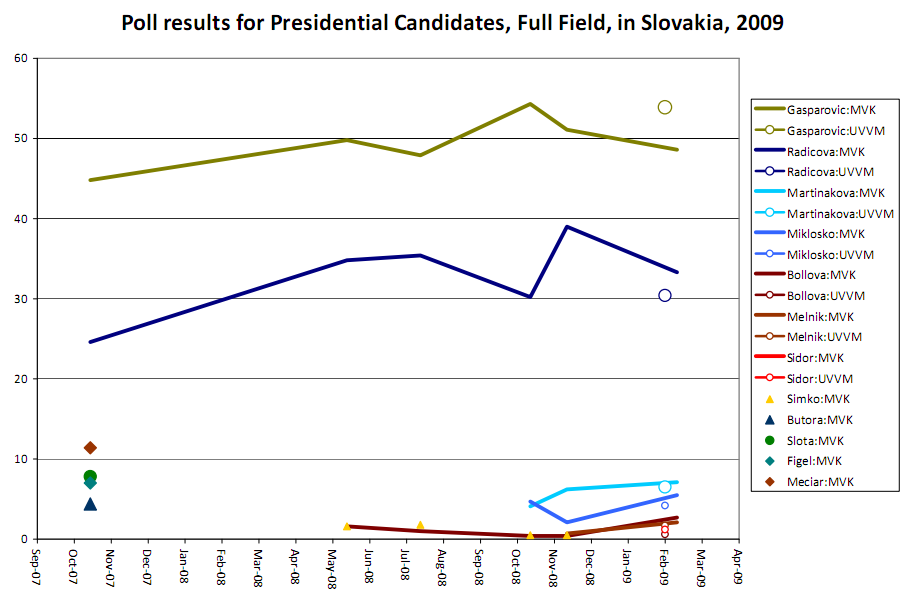
 I should probably post something on the presidential election campaign in Slovakia, though there is not much to say, both because the race has been extremely stable and because I simply have not been able to find much polling.  FOCUS has not yet offered numbers and UVVM only started this month (as far as I can tell) and so we’ve only got irregularly and incompletely reported numbers from MVK.  Still, that is something.  The race as we know it appears below.  Gasparovic has consistently led the field, hovering around 50% in every poll except a very early one in 2007 that included likely competitors from the Slovak national bloc (Meciar and Slota).  Radicova, by contrast has hovered around 35% (except in that first poll at a time when she had less name recognition).  Other candidates have gone and come, but Martinakova of Slobodne Forum appears to have a solid 5% and Miklosko of KDS just a bit less.  At the bottom comes the trio of Bollova (former KSS), Sidor (KSS) and Melnik (HZDS) with 2% or less.

Poll results for Presidential Candidates, Full Field, in Slovakia, 2009

Comparing these candidates with their party results is not always easy or useful but it does lend certain insight into the underlying dynamics of the country’s politics.  Gasparovic has polled 50% when his own former party HZD has languished below 2%. Clearly Gasparovic gains most of his support from Smer and SNS (though he slightly underpolls the combined strength of those two parties).  Gasparovic may also gain some support from voters of his previous former party, HZDS.  This is mitigated to some degree by HZDS chair Vladimir Meciar’s idiosyncratic campaign against Gasparovic, whom he regards as a traitor to his party, but while this campaign may cost Gasparovic some votes, it certainly has not been successful in luring voters to HZDS’s own candidate, Melnik, who stands at 2%, less than a third of HZDS’s 6% (and it shows HZDS’s continued decline).  Bollova and Sidor together attract more votes than KSS, but only by about a half of a percentage point, so it does not seem that these alternatives on the statist left draw many voters away from Gasparovic.

Perhaps the most interesting question is on the right.  The parties of the right (including the Hungarians) consistently poll about 35%, about equal to Radicova’s total, but Radicova likely shares the vote of that bloc with Martinakova and Miklosko who together poll around 10%.  This means that either Radicova or the other two (or all three) pull some voters from uncommitted voters.  Martinakova outpolls her party by about 3-4%) and Miklosko’s party has only about 1% in the polls, so virtually all of his vote comes from partisans of other parties.  It is difficult without the actual data to assess the ebb and flow here, but it would appear that the presidential candidates of the right-wing parties are, by a solid margin, more popular than the parties themselves, and this suggests some room for growth on the right side of the political spectrum (but only if those parties were to seek out new leadership, something that KDH and SMK–but not SDKU–may currently be thinking about).

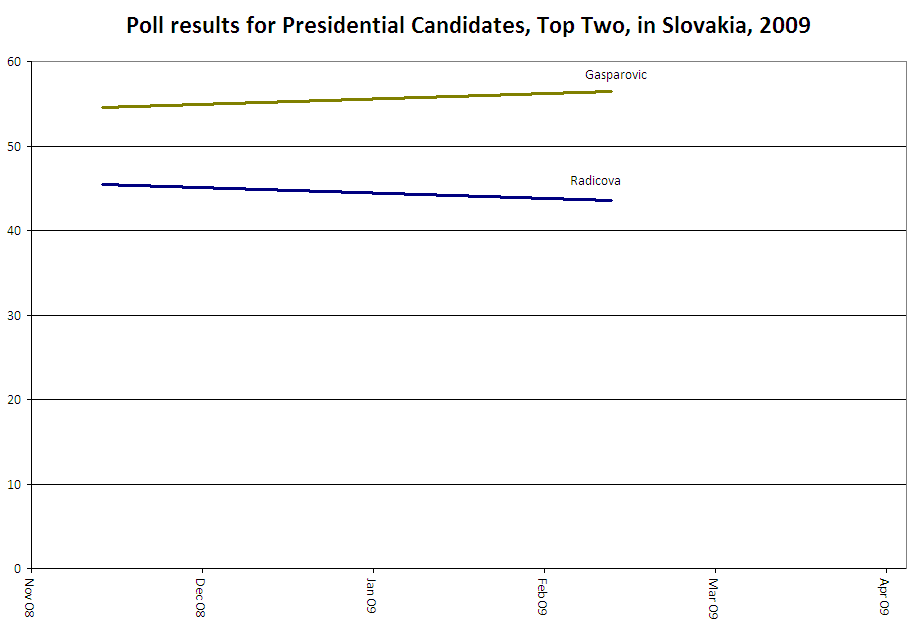
The potential gain becomes most obvious in those polls that pit Gasparovic directly against Radicova.  In these, surveys (of which we have only two, both conducted by MVK) Radicova draws closer to Gasparovic, gaining an average of 8% compared to Gasparovic’s gain of 5%.  This is to be expected since the candidates closer to Radicova (Martinakova and Miklosko) have more support than those closer to Gasparovic (Bollova, Sidor, Melnik), but it is still noteworthy since it suggests that a moderately charismatic candidate of the right can gain significantly larger numbers of voters than do the parties of the right.

Poll results for Presidential Candidates, Top Two, in Slovakia, 2009

January 2009: FOCUS echos UVVM

January 2009 poll comparisions and averages

I should have known to wait for the FOCUS numbers to come in before writing yesterday’s post.  FOCUS is coming in much more quickly these days.  This month, however, one or the other would have been enough as the results are strikingly similar.  The two polls show the same trends for every major party.
For Smer the two moved in the same direction, almost perfectly.  Gone may be the day when FOCUS was much lower than UVVM on numbers for Smer.  Whether this is the result of a shift in network, methodology or the end of a long string of chance differences, I cannot say.  (Anyone know the answer?).  This month showed a decline from a peak in both.

Multiple-poll+average+ for +Smer+ for the most recent +4+months+ in Slovakia

For SDKU the resultsof the two polls have been shockingly close for three months now.  SDKU has stabilized, perhaps helped a bit by Radicova’s presidential campaign (perhaps not).

Multiple-poll+average+ for +SDKU+ for the most recent +4+months+ in Slovakia

This graph of recent results for SNS shows a fairly wide divergence but similar trending–very slowly downward since December.

Multiple-poll+average+ for +SNS+ for the most recent +4+months+ in Slovakia

This graph of recent results for MK shows a slight rise in both polls, though the 2% gap is wide for such a small party.

Multiple-poll+average+ for +MK+ for the most recent +4+months+ in Slovakia

The two polls’ numbers for HZDS are (as they have been) incredibly similar.  HZDS has reached its lowest recorded numbers in both polls (though with FOCUS this represents a tie with its numbers from August 2008).

Multiple-poll+average+ for +HZDS+ for the most recent +4+months+ in Slovakia

This results for KDH show greater similarity between polls than during much of last year.  Both polls have shown essentially identical results for January and February and this time it is good news for KDH which has risen in both, even after its vice-chair Daniel Lipsic raised a storm by talking about his party’s participation in the “buying” of deputies during the previous parliamentary term.

Multiple-poll+average+ for +KDH+ for the most recent +4+months+ in Slovakia

This graph of recent results for KSS shows little change from last month with the two polls placing the party in its traditional zone between 2 and 3%.

Multiple-poll+average+ for +KSS+ for the most recent +4+months+ in Slovakia

This graph of recent results for SF shows a small gain in both surveys moving it toward 3%, up notably from its nadir a year ago at less than 1%.  The party’s gains have been steady, so it is difficult to attribute this solely to the increased visibility due to party chair Martinakova’s presidential bid, but this may help.

Multiple-poll+average+ for +SF+ for the most recent +4+months+ in Slovakia

The two other oft-polled parties, remain insignificant.  ANO broke 1% for the first time in 5 months in the FOCUS poll but was nearer to zero in the UVVM poll; after some respectable (for it) showings around 2% in the past months, HZD is back at around 1% in both polls.

Finally, FOCUS has decided to continue with its addition of small parties–KDS, ZS and LIGA.  Each of these parties did better than in the previous month of polling by FOCUS: ZS rose from 0.4% to 1.0%, almost identical to its 1.1% result in UVVM polls.  KDS rose from 0.3% to 0.6% (at the same time that KDH rose several points) in the FOCUS poll.  LIGA rose from 0.3% to 0.4%.  So far SaS is present on the polling list only of MVK and we do not have MVK numbers for January or February.

Since the two polls showed such similar results, averaged all together it is almost indistinguishable from yesterday’s report on UVVM.  Smer leads, SDKU stays stable, SNS and HZDS drop slightly, KDH and SMK rise.

2:||||||||||||||||||||||||

UVVM+poll+data+ for +all+parties+except+Smer+ for the most recent +4+months+ in Slovakia

This means that the coalition stops its climb and the opposition stops its fall and so we are back almost exactly to mid-2008, though with HZDS a bit weaker and Smer a bit stronger.

Multiple-poll+average+ for +coalition+support for the most recent +24+months+ in Slovakia

The only really noteworthy result of analysis by bloc is that the “Slovak National” bloc falls to its lowest recorded levels (around 18%).  I doubt that these voters have lost their national sentiment, but they may have shifted to KSS or Smer (or even KDS?) which are not exclusively nationally oriented.

Multiple-poll+average+ for +party+blocs+ for the most recent +24+months+ in Slovakia

This month’s distribution of parliamentary seats shows that this all makes little difference so far in the big picture.  As always, Smer can form a government with only one partner (and since the numbers putting Smer with a simple majority last month were unlikely to be reached in an actual election, this is the way it has been essentially since the 2006 election.)Multiple-poll+average+ for +estimated+party+seat+distribution for the most recent +1+month+ in Slovakia

Multiple-poll+average+ for +estimated+party+seat+distribution for the most recent +24+months+ in Slovakia

As always, the actual polling numbers are available online at Google Docs:
http://spreadsheets.google.com/pub?key=pdhlCClsiyAMi39bLFpY_Zg

And the most recent three months are below in tabular format (using “iframe” which may not work on all browsers).

<br />

February 2008 UVVM: Coalition down slightly, new counting method for UVVM

UVVM Monthly Report for December 2008

If you set your frame narrowly enough, things can change quickly. In the big picture, nothing much has changed since last month, and the relative positions of parties are pretty much as they have been for the last two years.  Within that narrow frame, however, the current coalition has gone from near-highs for the post election period to near-lows thanks to drops in all three of the coalition parties, the first time all three have dropped simultaneously since late 2006.

Of the three, Smer’s drop was the largest but by far the smallest in percentage terms and the drop occurred after one of the party’s near-high scores, so some correction may be expected.  This month’s 46% is still one of the party’s eight highest scores over the last 30 months.
UVVM+poll+data+ for +all+parties+ for the most recent +24+months+ in Slovakia
UVVM+poll+data+ for +all+parties+except+Smer+ for the most recent +4+months+ in Slovakia

For the other coalition parties, the drop was more significant, with SNS sliding back toward the 11% mark after a high point late in 2008 and HZDS dropping to its lowest mark ever recorded in a major survey, the first time the party has ever received less than 6%.  Of course there is a lot of noise with smaller parties, but HZDS’s tendency to hit new lows every six months or so and its inability for its occasional highs to rise to the levels of previous highs cannot be happy news within the party.  The graph below suggests that the party is not yet in danger of dropping below the 5% threshold in the 2010 election, but the danger is getting closer, particularly since party regularly varies more than 1% from its trendline average meaning that with current trends there is a strong chance that the party will post at least one or two results below the 5% threshold in the months just before elections, a symbolic result that could further hurt the party’s chances.

HZDS trendline

For the opposition parties in parliament, this was a good month, especially for KDH which seemed to be facing a slide as serious as that of HZDS. Again there is a lot of noise and variation here but this gives the party a brief reprieve.  Overall, as the graph below shows, the opposition parties are back near their high point for the post election period.  Unfortunately for them, this is a paltry 33%.

UVVM+poll+data+ for +coalition+support for the most recent +24+months+ in Slovakia
UVVM+poll+data+ for +party+'blocs'+ for the most recent +24+months+ in Slovakia

And unfortunately for them, Smer is still within striking range of a one-party government.
UVVM+poll+data+ for +estimated+party+seat+distribution for the most recent +1+month+ in Slovakia

UVVM+poll+data+ for +estimated+party+seat+distribution for the most recent +24+months+ in Slovakia

As always, the actual polling numbers are available online at Google Docs:
http://spreadsheets.google.com/pub?key=pdhlCClsiyAMi39bLFpY_Zg
  And the most recent three months are at the bottom in tabular format (using “iframe” which may not work on all browsers).

It is worth noting here, however that UVVM has changed its method for asking about voter participation and that this can have effects on the overall results.  As the table below shows, UVVM has changed its question three times in the last two years, switching to a “Do not sympathize with any” response after the 2006 election and then in 2007 changing back to the method it used before which allows a “will not vote” response.  This new option lowered the number of people who specified a party from an average 0f 74% to an average of 68% (though increasing disillusionment with all parties could explain some of the decline).  Now UVVM has split the question into two parts, first asking whether respondents will vote at all and then asking whether for whom they will vote. Asking first about voting has the immediate effect of increasing the share of “will not vote” responses by 8 percentage points.  In the second phase, the survey asks those who will vote to specify a party and here too it allows a “do not know” response.  Between the 8 point increase in “will not vote” and the 3 point increase in the combined “do not know” (respondents who do not know if they will vote and those who do not know for whom they will vote), this method produces an 11 point drop in those who actually specify a party.  Whether this is good or bad is hard to say.  It suggests a lower level of turnout–and I suspect the purpose of the shift is to fix UVVM’s overprediction of turnout in 2006–but whether it is a more accurate measure of results is hard to say.  It is notable that it does not substantially alter the overall party preferences, all of which stay within a few percentage points of their numbers using the old method.  Of course the only way to really test the effect is to ask both sets of questions at the same time, but this would double the expense.  More news on this as I find out any details.

2006 2007-2008 2009
For whom will you vote? For whom will you vote? Will you vote? For those answering “Will vote”: For whom will
you vote?
Does not sympatize with any 26.4          
    Will not vote 17.9 Will not vote 25.0
Does not know who to vote for 14.2    
    Does not know whether to vote 11.4
Will vote 63.6
Specifies party 73.6 Specifies party 67.9   Does not know whom to vote for 6.2
Specifies party 57.4

Finally, I should note that like MVK and FOCUS, UVVM appears to have added the Party of Greens (SZ) to its list of parties on the official roster.  At some point I will rework my software to include them here, but for the moment they remain at a single percentage point (close to the results obtained by FOCUS in January) and so not much is lost by their omission.  It is noteworthy that only one in a thousand respondents (here it can only be one out of the 600 asked) specified a party not on the list, suggesting that there is no spontaneous support for KDS, Liga, or SaS.

<br />