Less than perfect public opinion coverage in Slovakia

 [Citajte post aj po slovensky]

“Less than perfect” could be the title of nearly post on polling coverage in Slovakia (hence, in many ways, this blog), and I shouldn’t be too critical but today both major papers went out of their way to mangle polling data.

In SME: “New party Most already clearly drawing Csaky voters” cites a Polis poll showing SMK at 5.7%.  Not only does the paper fail to assess whether Polis does good polls (they use telephone surveys which are problematic and they haven’t released a party poll for a long time so we just don’t know for sure–but more on that in a later post) but it suggests a trend–and a causal relationship even–on the basis of one data point.  We simply don’t know how SMK polled in previous Polis polls this year because there haven’t been any (at least I haven’t seen any and the paper certainly doesn’t provide them, using the 2006 elections as a frame of reference, as if that told us about polling trends).  Other polls did show SMK higher in previous months, but all polls do not sample populations the same way, and even UVVM had trouble with even samples of the Hungarian population (http://www.pozorblog.com/?p=110), and showed a result for SMK as low as 6.7% in September of 2008.  I’m not saying that Most-Hid is not pulling away SMK voters–in fact I suspect it is–but there’s no way of knowing it from the information we’ve got here.

In some ways worse, both SME and Pravda use the same data set to talk about the woes of HZDS.  SME simply makes the same mistake as above, suggesting that “HZDS continues to decline” on the basis of only the one Polis poll, without attending to the fact that different polls show different levels for parties and ignoring the fact that this month’s FOCUS poll show’s HZDS rising by more than a point, from 4.2 to 5.3.  Pravda’s story, “Meciar not bothered by polls does something rather worse, citing not only the Polis poll but also the numbers from FOCUS for April (4.8) and May (4.2) without feeling obliged to report the big increase reported in June.  It is clear to me that HZDS is in trouble, (and these microtrends usually don’t add up to anything, so I wouldn’t argue that HZDS support is actually increasing), but citing the first two numbers of a sequence of three seems a bit beyond the pale when the third number tells the opposite story.

June 2009 FOCUS Results

FOCUS Monthly Report, June 2009

[Citajte post aj po slovensky]

With no more results from UVVM to kick around anymore and only irregular announcements from MVK, we’re left with FOCUS (quite a good poll but it was always better to have a comparison set) though “Median” appears for better or worse to be filling some of the void (more on this in a future post).  As a result, I’ve temporarily adapted my monthly tracking graphs from UVVM to FOCUS and will use those until I can shift to a new visualization system this fall (with any luck).

UVVM+poll+data+ for +all+parties+ for the most recent +24+months+ in Slovakia
This overall long-term graph of poll results for FOCUS shows, amid the overall stability, several minor shifts, most notably a drop in Smer, fairly consistent over the last months (and also suggested in the final, unpublished UVVM numbers) from its highs at the beginning of the year. Given past disastrous guesses, I’ve withheld judgment on this, but, I’d now guess that January 2009 might prove to be Smer’s all time record high point (more on that in a later post).  Also obvious is SDKU again separating itself from the pack in the middle, both because SDKU is doing better and because its closest competitor, SNS is doing worse.  That middle “Gang of 5” parties all around 9% has largely disappeared now that SDKU is doing so much better and because HZDS is doing so much worse (though it has picked up slightly this month and moved back above the 5% threshold).  In fact HZDS is now closer in preferences to KSS and SF than to any of the current parliamentary parties (Median’s numbers for HZDS are higher).  The gang of 5 is likely to disappear altogether next month if Most-Hid manages to pick up a significant number of SMK voters.  Over the coming months I will be reworking the system to include the many smaller parties that have emerged of late and about which FOCUS now asks explicitly.  For the moment it is worth noting that the Greens (SZ) and Freedom and Solidarity (SaS) now accompany KSS and SF in the 1-3% range whereas the Conservative Democrats (KDS), Civic Conservatives (OKS) and Civic Liberals (Liga) languish with ANO and HZD under 1%.
UVVM+poll+data+ for +all+parties+except+Smer+ for the most recent +4+months+ in Slovakia

As a result of these shifts the long-term graph of poll results for coalition and non-coalition parties shows something of a narrowing, though not one that should give too much joy to the current parliamentary opposition, because a large and increasing of those “non-coalition” votes are actually votes for parties that are either not ideologically in sync with the current opposition (KSS) or parties that probably won’t make it into parliament unless there is some consolidation of small parties on the right (SaS, SF, Liga, ANO, KDS, OKS).

UVVM+poll+data+ for +coalition+support for the most recent +24+months+ in Slovakia

The long-term graph of poll results for (loosely defined) party “blocs” parties shows a steady drop over time for the more explicitly national parties (though recovering a bit in the last three months from record lows, with many of those voters apparently shifting over to Smer while the “right” remains relatively stable (this graph does not include the non-parliamentary parties on the right).

UVVM+poll+data+ for +party+'blocs'+ for the most recent +24+months+ in Slovakia

For all these slow shifts, Smer is in no danger yet of needing two coalition partners.  One will do.  Though speculation has involved the possibility that the “one” in question might be SDKU, I suspect that if things stay as they are, Fico’s partner will be whichever party is weakest and least likely to threaten Smer’s control.

Multiple-poll+average+ for +estimated+party+seat+distribution for the most recent +1+month+ in Slovakia

Multiple-poll+average+ for +estimated+party+seat+distribution for the most recent +24+months+ in Slovakia

Sorry, but I won’t be posting of full poll numbers this month or any time soon until I get the new system worked out.  More soon on the polls by “Median”.

In HZDS is everything possible

Except, perhaps, victory.

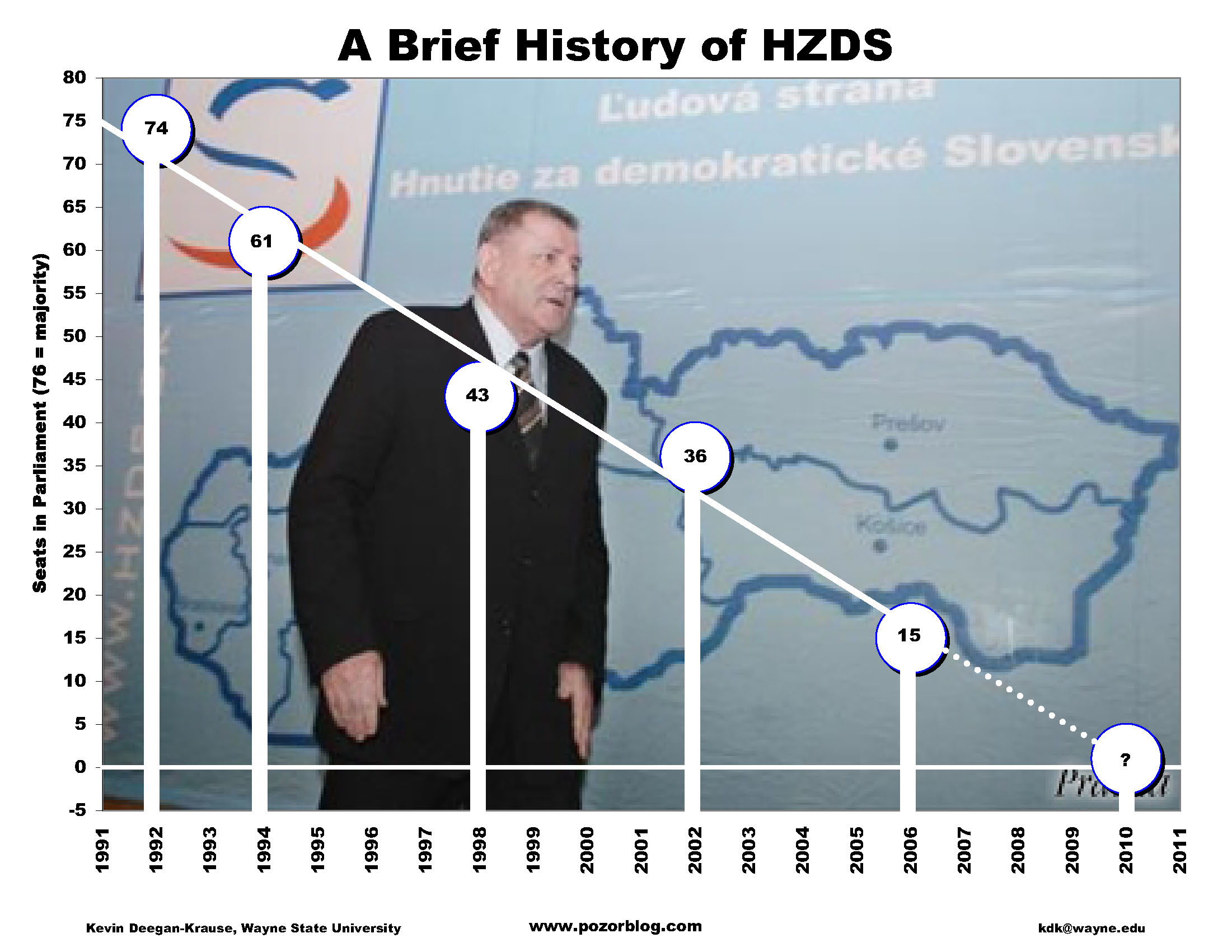
HZDS Trendline

Today brings more news from the ever-shrinking HZDS: last week it was Sergei Kozlik with criticism; this week it’s Zdenka Kramplova (see below).  The cost of criticism is lower now that HZDS has several times breached the threshold of electability: why refrain from criticizing a party that won’t get elected anyway.  Kozlik is safely in the European Parliament for another five years.  Kramplova won’t make it onto the party list of a party that may not make it into parliament.  For them, it seems, it may be time to leave the heavily-listing ship.  To its credit, HZDS may have managed one of the steadiest declines of any party anywhere, as if the Titanic had sunk so slowly that it managed to limp into New York harbor.  Except that for HZDS there is no harbor.

Meanwhile I learn new Slovak words every time SNS chair Jan Slota speaks.  This time the comments concern Smer’s Monika Benova-Flasikova (SNS vice-chair Anna Belousovova had something equally sharp to say about Benova-Flasikova last week)

———————–

“Kramplova not yet out of HZDS”
http://www.sme.sk/c/4902546/kramplova-zatial-z-hzds-neodchadza.html

In (babel) English here:

“HZDS is like a hamster in a wheel.”
http://spravy.pravda.sk/kramplova-hzds-je-ako-skrecok-v-kruhu-dwk-/sk_domace.asp?c=A090623_113718_sk_domace_p29

Something resembling a translation here:

“Slota: Benova is a stupid [goose]”
http://hnonline.sk/slovensko/c1-37543370-slota-benova-je-hlupa-husicka
Google tries here

New Parties: SaS does the electoral math

SaS LogoInteresting post today from Richard Sulik, founder of Sloboda a Solidarita (trendily-colored logo is at left, found not on a party website but on a Facebook page), who responds to the charge from SDKU that SaS hurt the right by causing voters to “waste” votes on a party that did not make it over the threshold (http://richardsulik.blog.sme.sk/c/196401/SaS-oslabila-pravicu.html).

Sulik makes interesting arguments to suggest that SaS voters had good reason to vote in other ways and that they might not have voted at all, but he also makes good use of electoral math to make his point:  he uses the electoral formula to show that  reallocation of all SaS to SDKU would only have reallocated the number of seats that went to the right (SDKU would have gained one but KDH would have lost one) and thus that SaS did not impact the final result.  The math looks solid to me and it is nice to see someone respond to arguments by looking at actual numbers and rules.

Nevertheless, it is not as easy to dismiss the SDKU arguments if they are seen as a warning about future elections.  SaS did not have much impact in the European Parliament elections because there were so few seats at stake (13 [Correction, thanks reader “Richard”).  Had it been a parliamentary election (and yes, many other things would have been different as well), Sulik’s argument is not quite as strong.  I’ve reworked his numbers assuming the 150 seats of Slovakia’s parliament at stake.  According to this, calcuation, SaS would have had a significant impact on SDKU votes (which would have gained 6 seats had it received all of the SaS votes) which is partially but not completely ameliorated by its impact on KDH and SMK (each of which would have lost a seat).  In terms of coalition and opposition, this is almost a crucial difference:  from clear parliamentary majority for Smer-SNS-HZDS to a bare majority that would hinge on the decision of only two deputies.

European Parliament Election Results if 150 seats (the Slovak Parliament) were available for election, according to two hypotheses:

Party SaS supporters vote for SaS SaS supporters vote for SDKU
Smer 56 53
SDKU 30 36
SMK 20 19
KDH 19 18
HZDS 16 15
SNS 9 9
Smer+HZDS+SNS 81 77
SDKU+SMK+KDH 69 73

Of course this is all theory, but the underlying debate is deeply relevant.  The more the fragmentation on the right, the worse it is likely to do (as the left and the Slovak nationals demonstrated in 2002), but it is not a zero-sum game and it may be true that Sulik’s party brings out new voters.  His ability to mobilize certainly is apparent in this election.  The question for me is whether the best use of Facebook/youtube/social networks is enough to attract the 115,000 voters who will likely be necessary to get a party over the 5% threshold in 2010?  The effort is certainly worth watching.

European Parliament Elections, Slovakia 2009

A few initial thoughts (perhaps my only thoughts) on Slovakia’s Europarliament Elections.
In general there are few surprises here:  Smer wins, SDKU follows at at a great distance, along with SMK and KDH.  Perhaps the only superficial surprise is the apparent reversal of numbers for SNS and HZDS, but even this is not particularly surprising in light of other characteristics of these parties.  As usual, it helps to look at the results against the background of polls and the previous Euroelection.  Full election results with comparisons to 2004 and to various polls are here and in a table at the end.

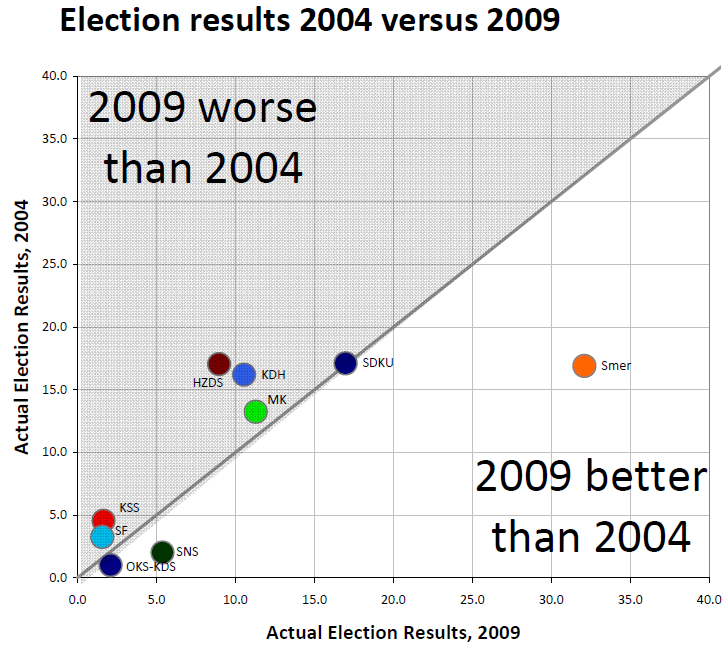
First, how does this look in comparison to the last (i.e. first) Euroelections in Slovakia, held in 2004.  Turnout appears to be slightly up, but slightly up from the lowest in Europe is still just the lowest in Europe.  In terms of party results, I’ve created a series of charts that array the parties on the Y (vertical) axis in terms of past performance, according to a variety of markers and the X (horizontal) axis in terms of present performance in elections.  Do that for the 2004 and 2009 results and here’s what you get:

pozorblog-euroelection-result-2004-v-result-2009.png

As is obvious, Smer does far better than before (over 30% compared with its disappointing under 20% in 2004), picking up 5 seats instead of its previous 3 and far outpacing the rest.  SDKU is next with results almost identical to those of 2004. Following a bit behind in a tight cluster are MK, KDH and HZDS, all performing worse than in 2004, by various margins and for various reasons (but more on that later) and then just above the 5% threshold, SNS.  All parties currently with seats in Slovakia’s parliament get Europarliament seats and no non-parliamentary parties make it across the threshold).

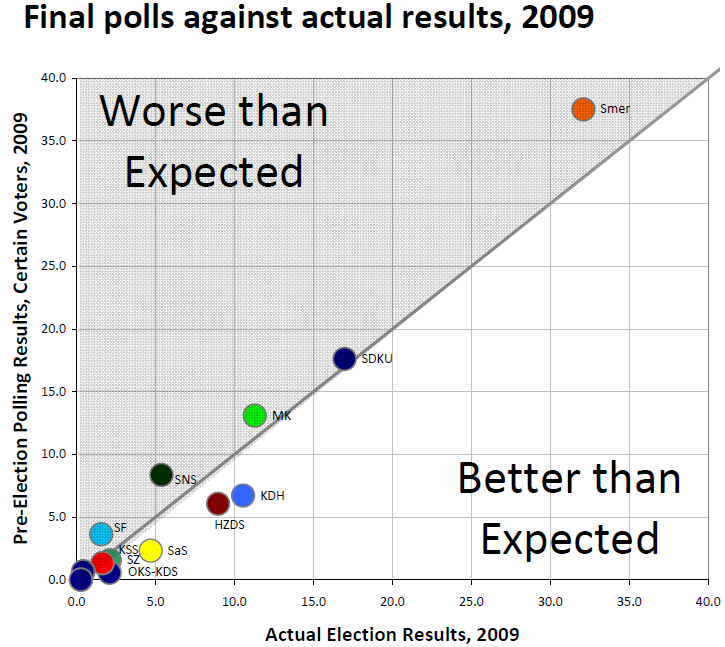
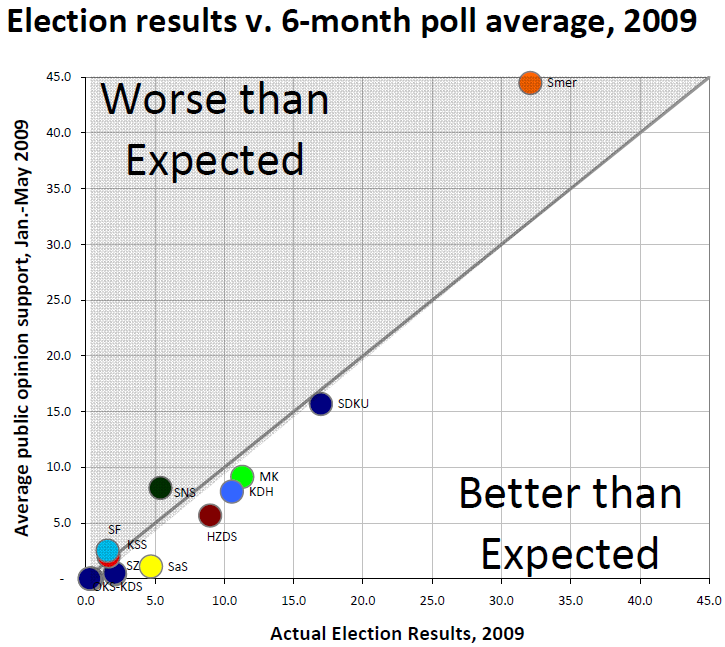
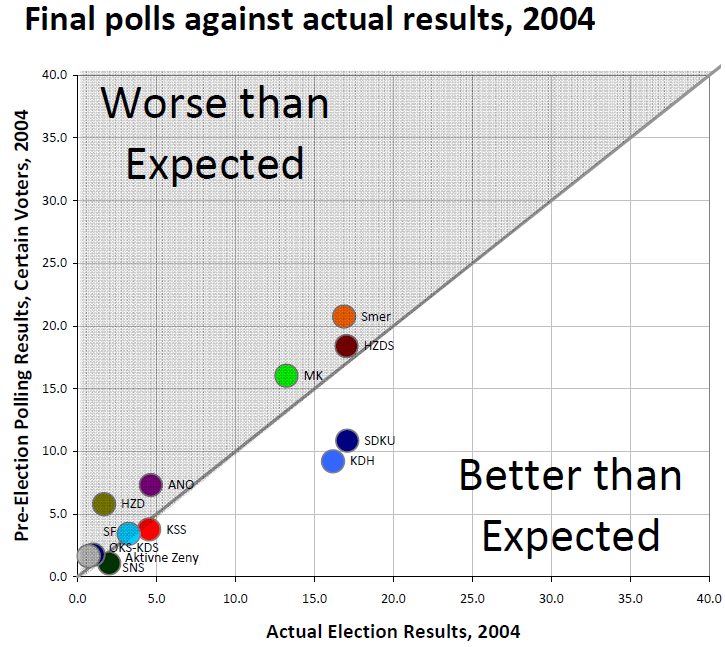
Clearly, by this standard 0f 2004 we have a major victory for Smer.  But there are other metrics.  A second way to look at this is to compare it to the most recent poll, does it beat expectations?  By that standard, this is what we get:

pozorblog-euroelection-final-polls-v-result-2004.png

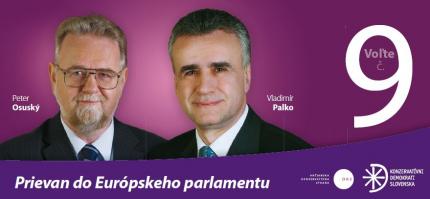
Smer and SNS do worse than expected, SNS by a slightly smaller raw percentage but a much higher relative share.  SMK does slightly worse than expected while KDH, HZDS and SAS do better.  What explains these differences?  Two of the three parties that did worse than expected also have the reputation (backed up by some research I’ve done) for weaker than average organizations.  In a low turnout election, organization makes a difference.  KDH and HZDS both have better than average organizations and and relatively stable, older than average electorates who dutifully turn out to vote.  SMK is also fairly well organized, but the party is currently in the midst of major turmoil (more here and more from me later).  The interesting addition to this list is SaS–Sulik’s Freedom and Solidarity.  New parties in Slovakia have rarely developed organizations that could push turnout in this kind of election, but Sulik appears to have made effective use of online social networks and other similar structures to mobilize young, educated voters who might otherwise stay home.  The bad news for SaS is that they just barely missed the chance to shake things up by getting a seat that would gain them some visibility and the same techniques will not have the same impact in higher turnout parliamentary elections in 2010.  Still, SaS will comes out of this strengthened vis-a-vis other small social-liberal parties (SF and Liga with quite bad performances, and the Greens not moving beyond their very small base) and has an opportunity to pick up the “disaffected SDKU” vote.  OKS-KDS did better than the previous year: Palko’s presence helped, no doubt, as the only party leader on the ballot of any party, but the party’s inability to push much beyond 2% in this election does not bode well for 2010.  KSS continues to hover around 1.5%, as it does in the polls, without much immediate hope of revival.

Finally, we can look at these results against the general recent performance of parties at the national level, averaging scores from FOCUS polls (now the only major one left that reports results fully and regularly) since the beginning of the year:

pozorblog-euroelection-poll-avg-v-result-2009.png

The results here are not wildly different from the previous graph, but it does suggest some cause for concern by Smer.  A 32% result in the Euroelections is great if it is double that of your next largest competitor, but slightly worrisome if it is 14% lower than the party’s average for the year to date.  Of course this is a low turnout election (this happened to Smer before in 2004, and even worse) but 2010 may not be particularly high either.  As with the presidential election, the results suggest that even with rather poor political play, the right wing manages to do better in elections than in the opinion polls (which show SDKU, SMK and KDH hovering around 30%-35%.  For now Smer is so far ahead that this makes little difference, but the party cannot afford to be complacent, especially, unlike its predecessor HZDS which once found itself in a similar position, Smer does not have such a strong organizational base to fall back upon.

The actual numbers are available online at Google Docs:

http://http://spreadsheets.google.com/pub?key=pdhlCClsiyAMi39bLFpY_Zg&single=true&gid=3&output=html

And the most recent three months are below in tabular format (using “iframe” which may not work on all browsers).

<br />

——–

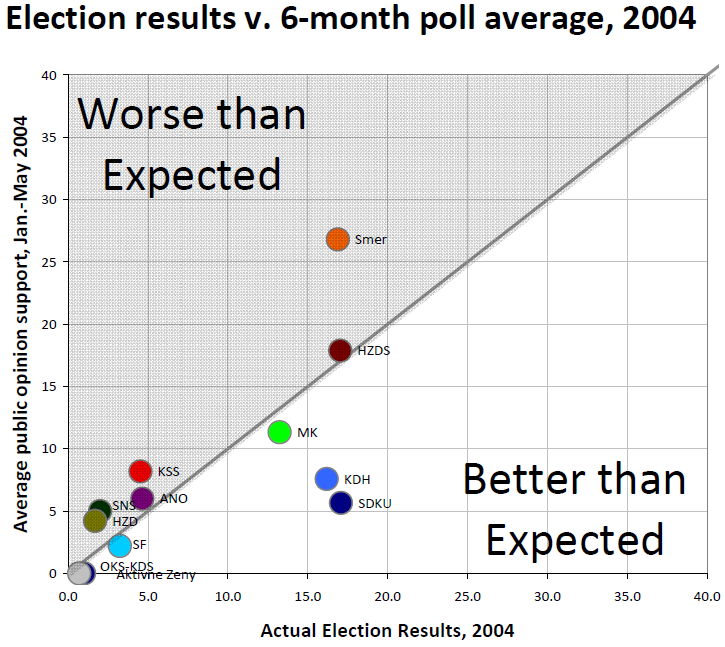
The main points are above, but in the process of making them, I made a few others that I don’t want to waste.  First, the polls v. results that parallels the one above.

pozorblog-euroelection-final-poll-v-result-2004.png

Here we see Smer’s slightly worse-than-expected performance and the dramatically better-than-expected performance of SDKU and KDH in 2004.  This is even more apparent in the poll average graph:

pozorblog-euroelection-poll-avg-v-result-2004.png

By this standard, 2004 really was a negative shock for Smer and a hugely unexpected bonus for KDH and SDKU and even to some extent for MK.  Here we see the “party organization” factor in full effect.

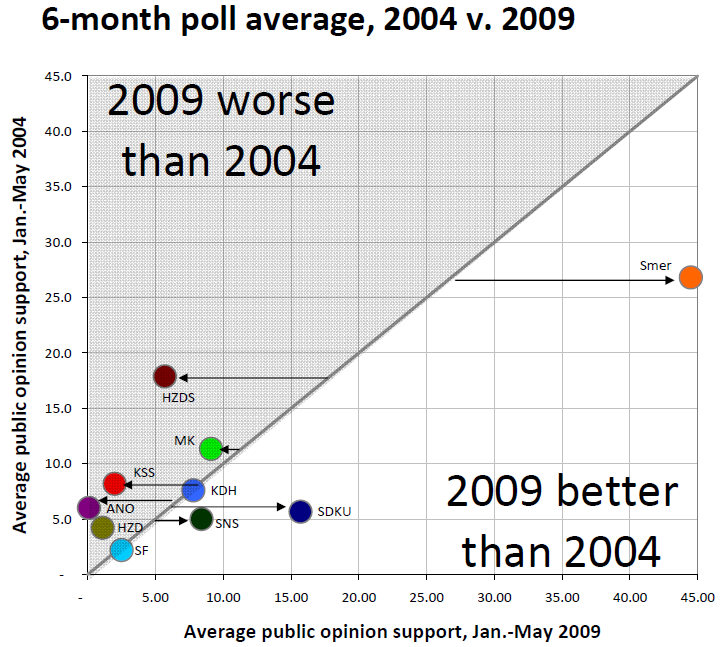
Finally, a graph that has nothing to do with the Euroelections but was calculated incidentally.  Still, it’s striking in what it shows:

pozorblog-euroelection-poll-avg-2004-v-2009.png

This blog has been talking about shifts in public opinion for some time, but this provides a great time-lapse image.  Smer is way up.  SDKU is up (though up over its polling numbers while in government rather than its actual election figures) as is SNS (though in 2004 it was coming off a disastrous couple of years after the PSNS split.  Its historical figures are actually around this level).  KDH is remarkably stable over time and has been since the mid-1990’s.  The losers are the small parties: KSS and ANO falling from electoral viability to near-death and HZDS falling from near-front runner to barely viable.  Amid all of this perhaps the most striking thing to me is the negative movement of MK.  This is a party which, except for actuarial reasons, should not move at all and yet it has fallen by several points.  Some of this may be the loss of a few Slovak voters who in 2004 still saw it as a clean alternative to the other members of Dzurinda’s then-coalition, but the party’s drop over the last 2 years suggests that it is due to poor politics.  Now we shall see what happens when there is an alternative party, but that is a topic for the next post.

European Parliament Elections: OKS-KDS

A reader (for all I know, since I haven’t enabled the statistics package on this blog, the reader) notes the OKS-KDS ties to Libertas and asks about the chances to break the 5% threshold in the upcoming European elections. My rather limited response:

This will be KDS’s first meaningful electoral test, since in the presidential elections KDS’s nearest competitor, KDH did not have a candidate.  It is good news that KDS is that it is running its best-known face, Vladimir Palko, who gets a lot of media coverage as a Slovak MP, but that’s the best news I can think of.  As far as I know, the party does not have any meaningful organization on the ground and not even, (so far as I can find) a website (and this party’s potential voters aren’t really web-readers, the absence is a sign, I suspect, of other organizational deficiencies).  Perhaps more notably, KDS has failed to get any opinion poll traction in the last year.  When it’s not explicitly included on the list of parties in polls, nobody mentions it spontaneously (“other” was for several months in several polls almost completely empty) and even when it is included, it hovers below 1%.  Perhaps worse, in the big picture, when Palko and Miklosko announced the creation of KDS the preferences for the party from which they split, KDH, did not drop at all.

OKS, for its part, may actually be slightly more organized (though that’s not saying much).  It has a few local government councilors and a website but I used to pass it’s empty, small office in Bratislava last year and rarely saw any activity and the website shows little beyond Bratislava.  OKS polled 1% in the 2004 Euroelections, and the party haven’t done anything to help itself since.

In addition to this, the field of small parties on the right is now remarably crowded and includes not only OKS-KDS but also 1) Slobodne Forum, 2) Sloboda a Solidarita, 3) Liga, and even 4) the  Demokraticka Strana (judging by its website an even paler shadow of its former pale self) and 5) Simko’s Misia 21.

The degree of alternatives raises a final, minor, question about the compatibility of OKS and KDS.  OKS may bring a little bit of organization; KDS brings a little bit of visibility (with its 4 MPs).  But at the same time, in a crowded market of small “right” parties, the combination might send some voters elsewhere.  Slovakia’s “right” is a mix of cultural conservatives and economic liberals (in the European sense) who do not always get along.  Among the mainstream parties, SDKU tends to attract the economic liberals and cultural liberals; KDH tends to attract the cultural conservatives while supporting some aspects of economic liberalism.  KDS has pushed hard on the cultural conservativism question, with strong Christian overtones whereas OKS, while not ignoring moral questions, seems shows more of an orientation toward an Anglophile conservatism rather than a religious one.  The party has few enough voters that the question may not be relevant, but I wonder whether Palko will push any OKS voters into the more economically liberal arms of Liga or SaS.

All in all, I don’t disagree fundamentally with Peter Horvath’s assessment that OKS-KDS has a better chance than many of the other smaller parties,  (http://www.panorama.sk/go/news/news.asp?lang=en&sv=2&id=19899) but that that is not saying much at all.  In a regular parliamentary election, I’d predict maybe 1.5%.  In a very low turnout Euroelection funny things can happen.  KDH significantly outperformed polling in the 2004 Euroelections, but the limited evidence I have leads me to think that this was because the party had a relatively strong organization at local levels.  KDS did not acquire those organizational assets, but KDS’s small electorate likely includes some of those high-turnout voters and maybe a few local organizers loyal to Palko, so the party may do a bit better than it would in a normal parliamentary election.

Euroblindness II: Curse of the Habsburgs?

Eurovision voting 2009

I could not bring myself to watch last night’s semi-finals of the Eurovision Song Contest (the finals will be enough, thank you) but I was amused to find this morning that virtually my entire region of study was wiped out in the voting over the last several days.  Thanks to a Wikipedia map (wow, that was fast) it’s graphically apparent that not one country from the Visegrad 4 made it past the semifinals.  Slovenia also didn’t make it and Austria (on the map in non-participant yellow) didn’t even bother.  The only other Euroregion to be similarly shut out was Benelux.

As a social scientists, I must ask why? The Danube appears to have something to do with this, and already yesterday Pravda prepared Slovaks for their unfair defeat by pointing out the non-musical charms of semi-final rivals and the academic qualifications of Slovakia’s participants.  But I’m putting my money on a different causal factor:

Mozart's travels in Europe

Past visits by Mozart (see above) appear to inoculate a country against selection to the Eurovision finals (Germany, France and England have automatic bids) and in some cases (Luxemburg, Italy, Austria, even from desire to enter.

Regardless of the causal factors, this spares everybody the awkwardness of having Slovakia’s 12 points go to Hungary and for that everybody can be grateful, except maybe Jan Slota of the Slovak National Party (who could use a national distraction from other troubles).

April 2009 Final Poll Comparisons

There is an old Communist-era joke in which one character asks the other, “Why weren’t you at the last party meeting?” and the other responds “If I had known it was the last party meeting, not only would I have shown up but I would have brought a bottle of champagne.”  In a similar–if more unfortunate vein–when I talk about the last UVVM survey of public opinion in Slovakia, I mean the last one.  The Statistical Office of the Slovak Republic has stopped the monthly public opinion polling on parties that gave Slovakia one of the most robust public-opinion tracking data of any country in postcommunist Europe.  The office has been discussing this for over a year (the director of the office, Ludmilla Benkovicova, discussed this with me in an interview in June 2008 and it was in the air well before then) but it is awkward for all concerned that the polling ceased precisely at a point when, according to a report by Pravda (http://spravy.pravda.sk/hzds-a-sns-nepadli-popularitu-straca-len-smer-faz-/sk_domace.asp?c=A090425_120119_sk_domace_p23) the ruling party, Smer, allegedly received its lowest support in over a year-and-a-half, and the ruling coalition allegedly received its lowest support since the June 2006 election.  I write “allegedly” because in addition to ending the party preference polls, the Statistical Office also embargoed the results of April poll that included those numbers and we have them in the public realm only because Pravda claims to have obtained a copy (which it also claims that Benkovicova did not deny).

It is hard to know what to make of Benkovicova’s decision since she cites an EU directive with which I am not familiar and since it is possible to make a good argument against government sponsored polls as the centerpiece of a country’s polling infrastructure.  At the same time, UVVM has done excellent work and has seemingly remained immune from political pressure.  Furthermore, while the circumstances and motives of the current decision might be entirely different, it is also worth noting that the last time UVVM stopped public release of polling information on political parties, it was during the government of Vladimir Meciar.  The polls came back after Meciar left.  We shall see if they do so again after Fico’s departure.

Because of the informal nature of the release of the UVVM April data, we only have a partial range of figures (none of the smaller parties or the share of non-voters) but fortunately we also have numbers from FOCUS for the most recent three months.  There are also numbers from the firm Median but I am hesitant to put these into the broader model as they lack the track record of the others.  I will try to do some more analysis of Median numbers and see over the next few month whether these are worthy of inclusion.

So what do we find. The graph averaging the last 24 months of polling results from multiple sources shows a drop for Smer back to the plateau it reached during the final months of 2008, the first time since the 2006 election that Smer has seen three consecutive months of drop.

2:||||||||||||||||||||||||Multiple-poll+average+ for +all+parties+ for the most recent +4+months+ in Slovakia

The drop comes off a record high, however, and so the news is not terrible, especially since while UVVM numbers showed a big drop (to 40%), FOCUS numbers showed the party increasing slightly.

Multiple-poll+average+ for +Smer+ for the most recent +4+months+ in Slovakia

This graph averaging the last 4 months of polling results from multiple sources shows this in more detail and suggests a minor shift in the overall dynamics of party competition.  Whereas originally there had been 4 groups of parties (Smer on its own above 40, SDKU and SNS between 10 and 15, HZDS, KDH and SMK between 5 and 10 and then a group of parties under 3, there are now 4 different groups (Smer alone, still above 40, SDKU in clear second above 15, SNS, KDH and SMK between 5 and 10 and parties under 3.

UVVM+poll+data+ for +all+parties+except+Smer+ for the most recent +4+months+ in Slovakia

This graph of recent polling results for SDKU shows a strong recovery–some of the highest poll numbers SDKU has ever had–perhaps because of the relatively strong performance by its presidential candidate, Iveta Radicova–but this bump may not long survive Radicova’s return to relative obscurity.

Multiple-poll+average+ for +SDKU+ for the most recent +4+months+ in Slovakia

This graph of recent results for SNS shows a consistent, slow drop even before the most recent ministerial scandals.  I am curious whether the apparently high levels of clientelism within the party can dislodge even its most passionately anti-Hungarian voters.

Multiple-poll+average+ for +SNS+ for the most recent +4+months+ in Slovakia

The wildcard here is HZDS.  In a February blog entry, I wrote that

“there is a strong chance that the party will post at least one or two results below the 5% threshold in the months just before elections, a symbolic result that could further hurt the party’s chances.”

That moment came sooner than I expected, at least in FOCUS surveys and so significant was the drop that I had to change the scale of the HZDS graph.

Multiple-poll+average+ for +HZDS+ for the most recent +4+months+ in Slovakia

HZDS has a strong cadre of loyal voters–stronger than most other parties of similar or even larger size, but at present the party’s slide is accelerating rather than slowing.  The current numbers put HZDS soon in the under 3% group.  The best case scenario for the party is somehow to hang on near the bottom of the 5%-10% group.
In broader terms these changes suggest a small closure of the gap between opposition and coalition parties, but the gap is still almost as large as the percentage of the opposition parties themselves.  It would take a lot to close the gap completely though of course “a lot” is what the current world economic crisis threatens to deliver.

Multiple-poll+average+ for +coalition+support for the most recent +24+months+ in Slovakia

The long-term graph of poll results for (loosely defined) party “blocs” parties shows parallel declines in the “left” and “Slovak national” blocs of parties and some aims for the opposition “right” bloc, but this again is not nearly enough for a change of government.

Multiple-poll+average+ for +party+blocs+ for the most recent +24+months+ in Slovakia

This month’s distribution of parliamentary seats shows Smer still in a position to form a one-party government with any partner, though its most likely partner, the Slovak National Party, is the one which has seen the dismissal of two ministers and a variety of other criticisms in a short period (though a variety of Slovak analysists suggest that the party needs its government posts (and the wealth to which they give access) too much to complain (http://spravy.pravda.sk/koalicia-vydrzi-sns-potrebuje-zostat-vo-vlade-zhoduju-sa-analytici-1pv-/sk_domace.asp?c=A090505_170429_sk_domace_p23)

Multiple-poll+average+ for +estimated+party+seat+distribution for the most recent +1+month+ in Slovakia

Multiple-poll+average+ for +estimated+party+seat+distribution for the most recent +24+months+ in Slovakia

And finally, because they did not fit into the narrative above (if such a disjointed string can be described as a narrative), a few other specific poll numbers.

The graph of recent results for MK shows stability and a degree of convergence among polls at around 8.5%.  The surveys were taken before Bela Bugar left the party’s parliamentary delegation, however, so we shall see over the next two months whether that has any effect.  We shall see over the next year whether we have a full split on our hands here.  If so, the normally solid representation of Hungarian parties in parliament may come under threat.

Multiple-poll+average+ for +MK+ for the most recent +4+months+ in Slovakia

This graph of recent results for KDH shows convergence as well with little change in average over time.  This is the one party to which nothing has happened over the last several months so the stasis is not unexpected.Multiple-poll+average+ for +KDH+ for the most recent +4+months+ in Slovakia

The graph of recent results for KSS shows a drop, particularly noteworthy since FOCUS numbers which usually put the party around 2% put it here under 1% for the first time in about a year.

Multiple-poll+average+ for +KSS+ for the most recent +4+months+ in Slovakia

Finally the graph of recent results for SF shows a steady rise.  Whether this party is a contender for 2010 (I predict that some pro-market social liberal rival to SDKU will flirt with the threshold in the months before the next parliamentary election but I don’t know that it will be SF, though that party has a better chance than some.  It has something of an organization and some name recognition, while neither Liga nor SaS appears to have yet found legs, but there may be another contender out there somewhere as well.

Multiple-poll+average+ for +SF+ for the most recent +4+months+ in Slovakia

FOCUS numbers show a stable 1.1% or so for the Green party (ZS) in the last two month, and really low numbers (between 0.1% and 0.5% for Liga and KDS.  OKS actually appeared above 0.0% for the first time in years (perhaps because FOCUS is asking about it now), and its emergence significantly undercut KDS (if anything can be called significant under 1% or understood as anything other than random noise.)

As always, the actual polling numbers are available online at Google Docs:
http://spreadsheets.google.com/pub?key=pdhlCClsiyAMi39bLFpY_Zg

And the most recent three months are below in tabular format (using “iframe” which may not work on all browsers).

<br />

Slovakia’s Presidential Election, Second Round

I have no time to day to do much analysis except to say that the weekend’s 55.5% to 45.5% is closer than I expected a year ago or even several months ago.  It means, in effect, at least 15% of the voters of the current coalition (Smer, SNS, HZDS) and opponents of the previous coalition (KSS and HZD) crossed the aisle and voted for a candidate from the previous coalition. This is even more strking to the extent that Radicova ran for president as a member of a party sharply at odds with all of the parties listed above.  Gasparovic by contrast has been able to maintain an arm’s length distance from unpopular actions by major parties, though this may have cost him as well since he lacked formal ties to party organizations.  In any case, Slovakia’s opposition has clearly been delighted by this result.  The question for me is whether the result will inspire them to compete vigorously or whether (as in the 2nd place but surprisingly strong finish of SDKU in 2006) will lead to complacency.  It would not be the first time that SDKU and its allies had failed to correctly read the electoral tea leaves.

As a side note, I realize that my epic prediction from last week actually never made it into the blog thanks to a mistake I made in formatting.  That’s just fine, but I’m happy with the form of the prediction at least and so I include it here.  I was off by about 1.2% but given what we knew, I suspect that a random guess limited by the parameters we had in front of us would have yielded an equally good guess:

  Total 1st round Share to Gasparovic in 2nd round Share to Radicova in 2nd round Total to Gasparovic
Gasparovic 46.71 1 0 46.71
Radicova 38.05 0 1 0
Miklosko 5.41 0.6 0.4 3.246
Martinakova 5.12 0.2 0.8 1.024
Melnik 2.45 0.8 0.2 1.96
Bollova 1.14 0.8 0.2 0.912
Sidor 1.11 0.8 0.2 0.888
Sum 0 0 0 54.74

And a final note.  I argue last time that if Radicova could increase Hungarian turnout she might be able to win.  She did manage to increase turnout in those places and still only picked up 6.5% overall.

First Round, Second Round

Turnout, First RoundTurnout, Second Round

The rest of the results are available on the website of Slovakia’s statistical official.  I’ll just post the pictures.  The sharpness of contrast is noteworthy, a range from 15% to 95% for Radicova, and 5% to 85% for Gasparovic.  By my rough estimation, that is quite high (as high as the difference in Ukraine in 2004, though the split is not as pervasive):

Gasparovic:

Gasparovic

Radicova:

Radicova

Presidential Election, First Round

Although the results were closer than almost anyone expected, the polls were not wildly off: only by a matter of 5-6% points and much less for the major candidates.  The closeness makes the second round interesting, though it’s much harder to see Radicova gaining 12 than Gasparovic gaining 5.

If the same voters were to turn out, it would be easy to make predictions, since we can guess fairly well about the 2nd choice preferences of voters for Martinakova, Bollova and Sidor.  For Miklosko and Melnik it is different (for related reasons):

  • Miklosko’s KDH fought bitterly with HZDS during the period when Gasparovic was the party’s chair of parliament and even though Miklosko will not back Radicova, many of his supporters may be willing to do so.  We shall see here whether past conflicts now rendered largely meaningless (ex-KDH v. ex-HZDS) will trump potentially emerging present conflicts over genuinely ideological questions (without looking more closely at the data, I would guess that Miklosko supporters are more similar to Gasparovic voters (culturally conservative, economically mixed) than to Radicova voters (economically mixed, culturally liberal).
  • Melnik’s HZDS fought bitterly after 2002 against Gasparovic and did so again in this campaign.  Here we shall see whether a current party conflict (Meciar v. Gasparovic) is stronger than a simultaneous ideological conflict (Melnik’s voters would unreservedly prefer somebody like Gasparovic over Radicova if it were not for the party ties.)  In this case I suspect ideology wins out and most Melnik voters go to Gasparovic.

This rough guess would produce something like the following.  Radicova gains more than Gasparovic but not enough to win:

Total 1st Round Share to Gasparovic in 2nd round Share to Radicova in 2nd round Total for Gasparovic Total for Radicova

Of course the same voters will not necessarily turn out and so if Radicova hopes to win, she will need a much bigger turnout in areas of her strength.  This might not actually be as hard as it seems since many of the areas of her greatest strength (particularly in the south) were in areas with rather low turnout, particularly along the country’s southern border.  Hungarians, it would appear from this aggregate data, may have supported Radicova at much higher than average levels but may have turned out in lower than average levels.  If this is true and if Radicova could mobilize Hungarian voter simply to turn out at average levels, she could come very close to Gasparovic’s totals :

Turnout

In the meantime, the daily papers have some reasonably good reportage (see: http://delicious.com/kdecay/pozorblog for articles I’ve tagged) and the Stasticky Urad has some other nice graphs and charts (see http://www.volbysr.sk).  For ease of comparision I’ve included some of the more interesting ones below.

Gasparovic’s regional totals:
Gasparovic Totals

Radicova’s  regional totals:

Radicova

Miklosko’s regional totals:

Regions “won” by Gasparovic versus those “won” by Radicova

Gasparovic v. Radicova