News and New Resources on Public Opinion in Slovakia

Update:
Because of formatting problems with certain versions of Internet Explorer , this page is now available as a .pdf file: 2009_12_30 Pozorblog Public Opinion.

I should begin with apologies for such a long hiatus and also with hearty congratuations to Monika Tódová of SME for writing one of the best articles on the process of public opinion polling in Slovakia: Prieskumy môžu politikov miast. It’s not very long but it finally addresses the problem of dueling headlines–“SaS/Most-Hid poised for success” v. “SaS/Most-Hid has no chance” (often in the same newspaper in the same week) and asks “How is it possible?” The answer lies in the ways that various pollsters survey the public, and it turns out (perhaps I should have known this) that FOCUS and MVK (and previously UVVM) offer a list of parties to choose from whereas Median gives no list. The latter method, of course, will tend to benefit those parties that are best known, while the former can give a boost to parties that are little known (and the process by which firms choose to add parties to their formal lists is fraught with difficulty.

The question now, is whether Todova’s article means a change in approach. Her article is the first instance I can remember outside of election campaigns when an article juxtaposes results from multiple pollsters. I can only hope that this will be the beginning of a trend even if (especially because) it might put this blog out of business. But I’m fairly secure that the time and space constraints of Slovakia’s papers will not let that happen and so there will be room for a blog obsessed with the minutiae of public opinion in Slovakia.

But just so that this blog does not immediately become obsolete, I want to share a new method I’m working on for displaying public opinion results. This is not quite ready for prime time, but using the Timeplot application developed as part of the astounding SIMILE project at MIT, it is possible to create dynamic charts that are fully modifiable and easily updated on the basis of simple text files. Of course that meant that I had to clean up my database, but now that that’s done, I should be able to present updated public opinion results with a minimum of effort (that’s the theory) and can even, theoretically, create a dashboard page on the blog itself for those who want to look at the numbers rather than read my analysis.

Below are examples of what is possible. I’m preparing a year end summary, so you’ll see these graphs again soon with some analysis attached.

Populism and Extremism in Foreign Policy

1177_titleI’ve recently prepared some thoughts on foreign policy of populist and extremist parties in postcommunist Europe and have uploaded an annotated presentation–see Populist foreign policy annotated.ppt or Populist foreign policy annotated.pdf–for those who are interested. It contains some thoughts on definitions of extremism and populism, makes reference to the excellent expert surveys by Hooghe and Marks et al and suggests that the two most important dynamics in assessing extremists foreign policy involve the tension between foreign and domestic policy (with domestic political needs usually prevailing) and the tension between extremist parties and their proximate “non-extreme” neighbors (and the more v. less extreme factions within those non-extreme parties).  An excerpt below:

When thinking about the broader patterns and how policy-makers should approach these, it is important to note that there are two important dynamics, areas of competition whose outcome has a critical impact on party positions and government policy. The first dynamic is the give and take between foreign and domestic policy arenas. While it may sometimes be the case that foreign-policy issues are highly salient and come first in the public mind, the evidence here and elsewhere (see Liang, Europe for the Europeans) that it is domestic policy questions—and quite often the quest for electoral advantage—that drives foreign policy positions. It is notable, however that extremism and populism have distinct patterns in this regard. In cases of purely extremism, the desire to exclude is often a genuine party goal, and parties may take foreign policy positions to reward those who dislike the same enemies or punish those who champion those enemies (as in the case of extremists increasing their opposition to the United States in response to US recognition of Kosovo, regarded as hurtful to Serbs and metaphorically as hurtful to those countries with large, regionally settled minority groups (Slovakia, Romania)

The populist dynamic can be the same as the extremist dynamic, though the populists may be more likely to employing the extremist cause for the sake of votes rather than out of genuine (this is an assumption and therefore likely to prove wrong on further investigation). The populist dynamic may also have another aspect, however that is relatively unique to populism: since populist parties (by the definition I have used) depend on attacks on a corrupt elite, they face difficulties once in power since they become elites themselves. Rather than seek alternative bases of support, the populist parties may seek instead to look for other “elites” above themselves toward whom they can allege corruption and against whom they can campaign. This may cause them to turn their attacks to major powers and supra-national organizations (the US, the EU) so that they can say, “yes we were elected, but now we’re fighting the real corrupt elite: them”

There is a second key dynamic at play here: the dance between extremists and those closest to the extremists on the “non-exclusionary” side of the boundary (a boundary whose location varies depending on the perspective of the observer and the context). The extremist parties themselves are rarely strong enough to shape policy directly, but they can do so in coalition or through their influence on vote-sensitive “flirt” parties. Parties such as Slovakia’s Smer and Poland’s PiS have demonstrated a willingness to enter into coalitions with parties with similar but more extreme positions on “exclusion” issues. The question, of course, is in which direction the influence runs, whether it is the extremist parties that shape the more moderate (but often much larger variant) or the other way around. Extremist parties can also shift the positions of moderate counterparts by forcing such parties into more extreme positions to avoid the loss of voters to the extremes, but only if they think they can do so without losing centrist voters. More work on such dynamics can be found in Przeworski and Sprague’s Paper Stones (1986) among many others).

Of course the interaction between extremists and moderates may also occur within individual parties and indeed most of the “flirt” parties and larger non-extremist populists have internal factions that represent a range of opinions from those near (or as extreme as) the extremist parties to those who hold rather moderate views on the same questions. The resulting policy positions depend on the complex interplay of coalition partners, intra-party organization and decision-making and voter preference. These are obviously highly contextual and so deciphering (much less predicting) these developments in particularly countries requires considerable local knowledge, even as broader, big-N research can help to identify relevant variables.

Twenty Years Ago Today: Challenges to Democracy in Slovakia

As part of the 20th anniversary commemorations in postcommunist Europe, America.gov (one of the U.S. State Department’s outreach websites) has been soliciting academics and journalists to write on “Challenges of Democracy” in the region (in 400 words or less!).  They were kind enough to publish my own thoughts (with no editorial intrusions) along with other comments about other countries from eminent commentators including Vladimir Tismaneanu, Janos Bugajski, Charles Ingrao and fellow Slovak Studies Association member Mark Stolarik.  My own take on the question (utterly predictable to those who read this blog on occasion) is below, but read it here instead so as to let the managers of America.gov demonstrate to their superiors that the idea was worthwhile.

Slovakia today faces several slow and subtle threats to meaningful democratic representation. These hardly seem dangerous when compared to the near-collapse of the Slovakia’s democracy in the mid-1990’s, but they are serious in their own right, especially because their subtlety makes them hard to see and even harder to correct.

Some current threats echo the problems of the 1990’s, particularly the growing politicization of the judiciary and other state functions and the sharpening of ethnic rhetoric. Questions of ethnicity in Slovakia are genuinely difficult, and it is no surprise that they remain at the center of political debate, but the shrillness of today’s exchanges risks long-term damage to relations between groups which have no choice but to live together. Although these problems are worrisome, Slovakia’s own recent history suggests that the cycle of alternating government and opposition tends to redress imbalances. Slovakia’s democracy survived worse periods of politicization and polarization, because Slovakia’s voters rejected extremes and opted for parties that offered more moderate alternatives.

But Slovakia’s political party system faces its own threats. Slovakia’s party system has become dominated by political parties which are less like classic European parties than like Internet startups: well-branded, CEO-driven organizations with a big-money investors, lots of consultants and short-term goals. They remain intact only as long as they continue to serve their function; otherwise they split or merge. Ordinary people become consumers, persuaded by flashy advertising campaigns to spend their vote on one product or another. These parties do not violate the formal rules of democracy, but the resulting interactions are thin and unsatisfying. In the worst case scenario, parties become vehicles for gaining office rather than for governing, and since they themselves do not expect to be around for more than one or two election cycles, they have little reason to pursue long-term and difficult policy changes. Faced with a parade of volatile new parties fighting for attention with famous faces and promises of renewal, voters become cynical about the political process and stop expecting that politics offers any solutions to public problems.

This problem is more akin to a chronic illness than a fatal disease. A sloppy, unresponsive, celebrity-driven democracy is still a democracy and can probably limp along indefinitely, but not without a huge cost in unsatisfied needs and wasted resources. Slovakia will not be alone in this—the same trends are emerging throughout the east and with only a slight lag in the west—but misfortune shared is still misfortune.

Reprinted from http://blogs.america.gov/democracy/2009/11/06/challenges-to-democracy-in-slovakia/

September 2009 Poll Results: Whither Smer?

This post comes a bit late because of changes to the pozorblog site but the month’s news is important enough to warrant an interim post.

Things only changed a little this month. But small changes from one month to the next add up. And this month not all the changes are small. A few areas to watch.

Smer

September 2009 Graphs_Page_01

As the image shows Smer remains far above its nearest competitors–still well over double the preferences of SDKU. But the last four months have seen a drop in Smer preferences from the mid-40s to the high-30s. This shift is primarily in FOCUS polls, however, and it is difficult to say whether the result is “real” or some sort of blip. Median, the only monthly alternative, shows no similar drop. I am really missing UVVM this month as it was always helpful to see what a second pollster said before making a judgment, and MVK polls are as unpredictable–in their appearance, not their results–as weather.

September 2009 Graphs_Page_05Closer look at Smer polls over time show a gradual increase over the last two years peaking in a cluster in late 2008 and then reverting back to the previous plateau and now, again to a lower level, though whether that lower level is part of a plateau or a slope is something we will have to see about. I suspect next month will show Smer higher in Focus polls but lower than its average level for the last 5 months. I suspect this month’s drop is a bit of an outlier, just as its previous peaks did not always sustain themselves and appear to be noise rather than signal.Smer doesn’t have too much to fear–it’s still hard to calculate a way that it won’t be in the next government, but it wouldn’t surprise me if some mid-level Smer types were starting to work on their political insurance policies.

SDKU and KDH:

September 2009 Graphs_Page_02Take Smer out of the graph and it looks more like a competitive party system. And this fall for the first time in a long time, the two top competitors to Smer are both from the opposition: SDKU and KDH. SDKU dropped slightly this month in FOCUS polls but it’s still near a historic high (in the past it would do this well in elections but not in polls). Some of its slight decline may relate to the rapid resurgence of KDH, a party that has taken a sudden upward jump due, I must think, to the energizing presence of Jan Figel, former European Commissioner. I am interested to see whether Figel’s more proactive approach will keep the party preferences high. In some sense, this does not help the opposition much, since those attracted to Figel are probably those who would otherwise hold their noses and vote for SDKU, but since they might also vote for SaS, it keeps votes among the larger opposition parties. Thumbnails for SDKU and KDH are here:

SDKU——————————————————– KDH

September 2009 Graphs_Page_06September 2009 Graphs_Page_10


HZDS and SNS:

Slovakia’s two minor governmental parties continue their respective slow slides, partly the result of Smer’s remarkable skill at picking off their voters and partly the result of their own internal struggles and disadvantages. HZDS has stopped falling for the moment but given the party’s steady 10 year slide and absence of anything new that might recommend it, it is hard to imagine anything but continued decline (with the key question: 5% or not 5% next June). SNS’s decline has been disquised at times by the party’s erratic support shifts but it is notable that all of the trendlines (24-month, 12-month, 6-month and 3-month point down at almost the exact same angle). The party has more leeway for falling than HZDS but it is not immune, and at some point SNS mid-level leaders are going to need to decide what to do if they feel that Jan Slota is pulling them down. The party’s structures are so focused around the party chair that the only way to force change will be to leave, but the last time they did that the parties split the electorate 50/50 and neither got into parliament.

SNS——————————————————– HZDS

September 2009 Graphs_Page_07

September 2009 Graphs_Page_09


SMK
and Most-Hid

Not much to say here, yet. For two polls in a row both parties are poised to make it into parliament. If this can continue then Bela Bugar has done a big favor to the Hungarian electorate, bringing back those disenfranchised from SMK. If both don’t stay above 5 and neither drops to near-zero, then the Hungarians will see their poorest electoral showing since the early days of Slovakia’s democracy. I’d be keen to hear any thoughts from Magyarophones about what to expect here as this is a subset of the population from which I hear little direct news.

SMK (regular graphs for Most-Hid coming soon)

September 2009 Graphs_Page_08

Smaller Parties:

Not much news here this month. SaS shows staying power at around 3%, and KSS recovered this month to its traditional 3% levels as well (though it has not been there for awhile). Below, around 2% stands SF (recovering slightly from a major drop the previous month) and at at the flatline level are OKS, KDS, ANO and Liga (which didn’t get a single person to mention it’s name this month even though it’s on the list). Between them are two more: HZD (slightly higher than expected–it’s been flatlining) and the Greens (somewhat lower than expected–last month it even beat KSS).

What it all means? The Coalition Partner Game

It’s still Smer’s ballgame, but coalition politics could become extremely interesting if Smer does end up at around 35% and HZDS or SNS fall below 5%. It is dangerous to trust what parties say about potential coalition partners, but as of now, SDKU and KDH appear to have ruled out coalition with Smer (Dzurinda is right, I think, to note that such a coalition would severely hurt his party, and he doesn’t have the organization or track record to ride it out the way ODS and CSSD did with their opposition agreement in the Czech Republic). But if this option truly is gone, then there are few other combinations that can make 50%. If the existing coalition can’t muster 50% because one party drops off, then Fico would need to find alternatives, but (even though I generally do not rule things out) there will be no coalition containing both SNS and either SMK or Most-Hid, and SaS, the only other party that looks now to have a chance, has promised up one side and down the other that it will not join forces with Smer. So Smer’s only real chance is probably SNS+HZDS or so many votes for parties that fall below the threshold that it can with SNS or HZDS form a bare majority government.

At the same time, there’s not much hope for a government of the current opposition parties. Even with SDKU and KDH and SMK and Most-Hid and SaS, there’s nothing like a majority. It might be possible to create one by adding HZDS to this but even that’s unlikely and HZDS is the party in greatest danger of falling short. In 10 short years, HZDS has gone from a huge and polarizing force in Slovakia’s politics to a tiny but necessary coalition partners. The more things stay the same, the more they change.
Minority minorities and the majority (or “party like it’s 1995″)

matrioskaToday’s SME reports “Ministry: Representatives of minorities supported amendment on the state language (http://www.sme.sk/c/4994369/ministerstvo-predstavitelia-mensin-podporili-novelu-o-statnom-jazyku.html).  We learn in the article that:

Predstavitelia chorvátskej, rusínskej, nemeckej, bulharskej, poľskej a ruskej menšiny na dnešnom zasadnutí Rady vlády SR pre národnostné menšiny a etnické skupiny vyjadrili podporné stanovisko k prijatej novele zákona o štátnom jazyku.

Which translates roughly as:

Representatives of the Croatian, Rusyn, German, Bulgarian, Polish and Russian minorities in today’s meeting of Slovakia’s Government Council for national minorities and ethnic groups expressed a supportive position to the passage of amendments to the law on state languages.

Without wishing to pass direct judgment on this story, I want simply to note that it is strikingly reminiscent of the efforts of Meciar’s Movement for a Democratic Slovakia to justify its own language law (and all of its other nationality-related policies) in the mid-1990’s.  The argument is a rather clever one: most nationalities do not mind the law, so why should the Hungarians (and sometimes Roma).  We love minorities (we even have a council for them) and minorities love us (they support the law), so Hungarians’ refusal to support this policy is a sign that they do not play by the same rules.

What the argument omits, of course, is that while from a technical standpoint, Hungarians (and Roma) are minorities when compared to the majority Slovak population, not all minorities are created alike.  Hungarians constitute more than 10% of Slovakia’s population and in some parts of Slovakia, they are the dominant population (something similar same can be said, though in slightly different terms, for Roma). The same cannot be said for the minorities listed above all of whom, according to the 2001 census, together total 35,868 people which is less than 0.7% of Slovakia’s population and 7% of its Hungarian population.  Unlike Hungarians (and Roma), Croatians, Bulgarians, Germans, Poles and Russians do not live in communities that would lead them to expect that they could lead lives in their own language without constant translation to and from Slovak.  (For Rusyns it is perhaps a bit different, but the language is close enough to Slovak that the translation is less difficult) and so the language law (and one can take a variety of views on its advantages and flaws) is not particuarly relevant.  Not so for Hungarians, in particular.  So knowing what Slovakia’s small minorities think about the language law is not particularly useful for making an assessment of the validity of the claims of larger minorities with what American congressional-district designers would call “majority-minority” communities.

I am curious whether this particular exercise of treating unequal things as equals (a strategy taken to its height in the US by columnist David Brooks) will go any further in Slovakia.  For Meciar’s HZDS, “treating all minorities equally” (a laudible goal unless there are reasons not to) was the mechanism by which the government marginalized Hungarian claims:  If a right could not be given to Rusyns or Germans, it would not be fair to give it to Hungarians.  If the state couldn’t support a Croatian-language university, it certainly wouldn’t be appropriate to establish a Hungarian-language university, and so on.  The HZDS government even went to the extent of publishing (with EU funds) a publication called “Nationalities News” in which identical stories appeared in Hungarian, Rusyn, German and Slovak.  (That many of the stories focused on the perfidy of Hungarians, including one on the Hungarian troops that crossed the border of Slovakia during the August 21, 1968 invasion was simply to add insult to the rather significant injuries that became possible once all nationalities were regarded as equals.)

In addition to the political ramifications, all of this points at two rather significantly different understandings of the relationship between Slovaks and Hungarians.  Many Slovaks hold the opinion that Slovakia belongs to them, ethnic Slovaks.  It is named after them, and they are the state-forming (statotvorny) nation.  Others are, if not guests (and even many with strong national views would not go that far), at least minorities, and to make distinctions among them would be inappropriate as well as politically inexpedient.  At the other extreme are Hungarians who argue that Hungarians are also a state-forming nation in Slovakia and should be entitled to all the advantages of living in a country in which one constitutes a majority.  (Actually, of course, there is a more extreme position that Hungarians in Slovakia should bring about their majority status by bringing the territory under the political control of Hungary.  For my part, however, I have never met anyone in Slovakia who would admit espousing this position, though I’m willing to admit that without speaking Hungarian I probably wouldn’t be likely to meet such people). It is notable, that those who claim Hungarians’ statotvorny status do not usually extend it also to Roma or Rusyns or Germans, and in that resemble their ethnic Slovak counterparts.

I will also be curious to see, as tensions rise, whether the philosophical justifications go as far as they did 14 years ago.

Wanted: Effective journalism in Slovakia

Median logoI know Slovakia’s journalists are overtaxed with all that is required of them, but there are things they could do to make things better without too much extra work.  Case in point: today all major Slovak news sources today report, almost word for word, a press release from the firm Median reporting poll results from July:
The reports differ a bit, of course: SME and TA3 have a graph, Pravda has a table with past results from Median, HN relates the results (with no actual evidence) to the effect of recent scandals.

What none of them does is to answer the important question about Most-Hid.  Median, for reasons that are not clear, does not report on parties that do not cross the 5% threshold, and all the papers report that fact.  What they do not do is to say just how well Most-Hid actually did.  Here’s where journalism comes into play.  If the role of journalist goes beyond simply typing (or in this case probably pasting what others send to you) then it may be to try to find answers to important questions.

So here’s my suggestion: call Median and ask them 

If Median won’t answer, ask them why.  Focus reports its polling results with an extremely detailed and effective one-page report.  UVVM used to do the same.  There is no reason the papers should print Median’s results unless they are willing to rise to the same (bare minimum) standards. If Median won’t play that way, write a story about the fact that Median won’t provide necessary information):

If Median won’t answer and you still want to figure out something about Most-Hid’s initial support (a quite important detail), here’s my second suggestion: do some math.

If you add up the total support for the parties listed by Median in past polls, you get a consistent result of about 97% for May and June.  That means other parties are getting about 3% (specifically 3.1% in May and 3.3% in June).  If you add up the total support for July you get 92.3%.  That means other parties got 7.7%.  Of course this doesn’t tell you how well particular parties did, but it’s worth reporting that the “Other” number rose by 4.4% and citing the FOCUS numbers which show that support for below-threshold parties actually did not change systematically during the same period (9.0% in May, 12.5% in June, 10.2% in August), meaning that a large share, of not all of the 4.4% probably went to Most-Hid.

Total cost of these important details: one phone call and/or 2 minute 3o seconds of addition and subtraction.

If this lack of effort applies in this specific area, it’s probably also true in areas where I do not read.  It’s time for Slovaks to demand better journalism.

August 2009 Poll Results: Bending The Mold

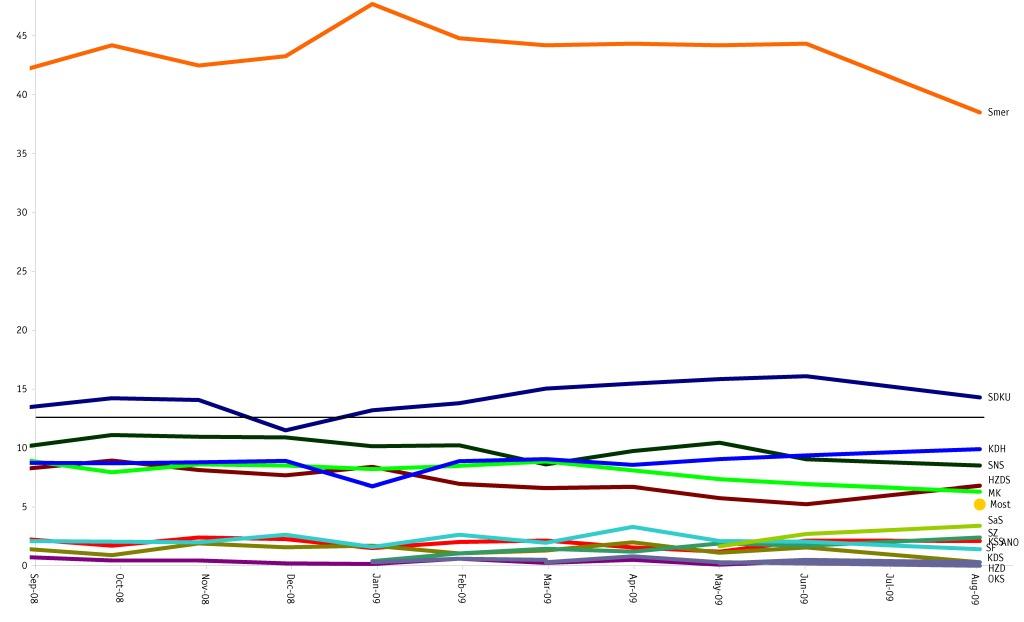
Poll results, last 12 monthsThe pattern looks familiar and the lines haven’t changed much, but there are a few ways that this month’s results by FOCUS change our understanding of the current political competition.

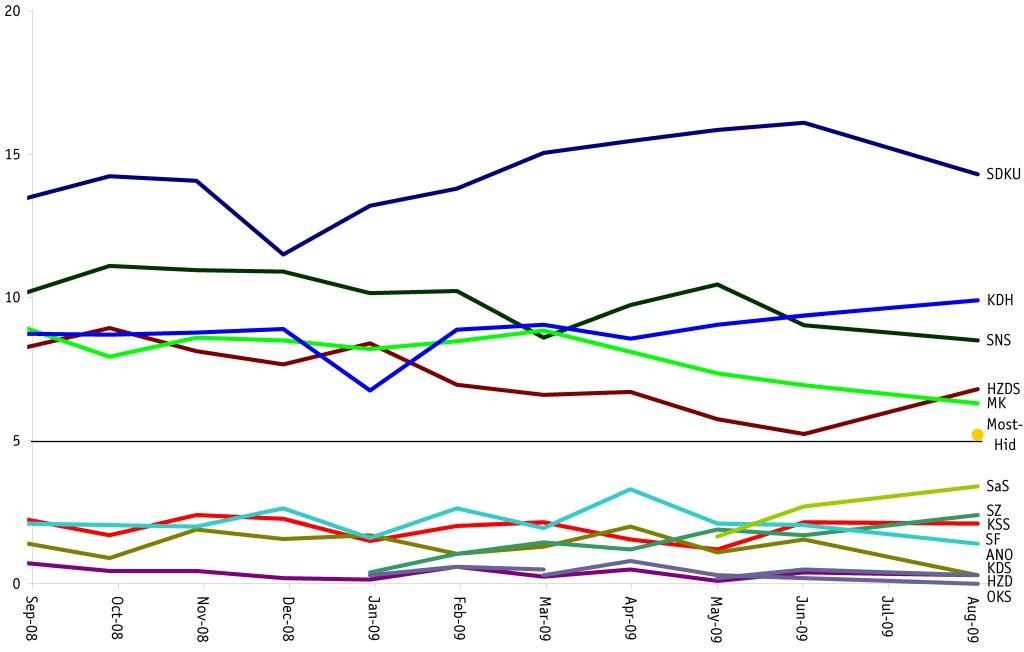
I have actually been fearing this change for a long time–not because of the actual politics involved but because of the emergence of a new party.  The graphs in this blog are the product of a long and complex process of fighting with Excel to produce results that can be read by Google’s chart API (about which I understand little, but which is quite remarkable).  That process has produced an elaborate set of calculations which are, unfortunately, based on the presumption of a certain set of parties (and only those parties) gaining election to parliament.  This month holds quite a few big changes in public opinion and one of those–the emergence of Most-Hid with just over 5% of the vote–means that my old systems won’t work anymore.  This is good news, in a sense, because it gives me the impetus to find a solution that will not require as much work (calculating in Excel, creating the google charts, posting separately to Google Docs), but for the moment it makes things more difficult.  I will therefore resort to Excel charts for awhile.  And now, after that pointlessly detailed introduction (I buried the lead again), the graphs and then some thoughts on anybody should care:

Poll results, last 12 months

And the same graph without the distorting scale effects of Smer:

Poll results, last 12 months minus Smer

1. Most-Hid might make it into parliament
This may not be a surprise (Bugar is quite popular among Hungarians) but it is important, and the way the numbers fell is important in several ways:

  • Most-Hid v. SMK is not exactly a zero-sum game.  This month’s 5.3 score for Most-Hid came at relatively little cost to SMK which has dropped only about 1 percentage point in the last 4 months.  Of course SMK has dropped quite a few percentage points since Csaky became party chairman (and even before while Bugar was still chair) but it would appear that the party has brought disaffected Hungarians back into the political system rather than stealing directly from SMK.  As a result, Hungarian parties combined scored the best public opinion result that Hungarian parties have received in almost 5 years (since January 2005).  All of the opposition’s gains this month can be traced to that single re-mobilization.
  • Both can get into parliament.  There has been some discussion about whether the two parties might split the vote down the middle (as SNS and PSNS did in 2002) and lose representation altogether.  The results from today suggest that a 50-50 split is actually an ideal result for the Hungarian population in Slovakia.  More worrisome would be a 60-40 split, cutting the Hungarian representation nearly in half.  Of course there are some who suggest that infighting among Hungarian parties could disaffect enough to push Hungarian turnout so low that a 50-50 split would deny representation to both, but this month’s good results come after bitter conflict, so it is hard to imagine how bitter the conflict would need to become to provoke the worst case scenerio.
  • Things are far from over.  It may be that these two parties split the Hungarian vote.  It is more likely that one will tend to prevail over the other, either Most-Hid because of more dynamic leadership or SMK because of stronger organization and tradition.  This is one of the keys to the outcome of the next election so it bears considerable watching.

2. SaS has a (small) chance
This is something of a stretch because the party is only at 3.4%, but unlike the other small parties on the “right” it shows a positive trajectory.  KDS has stalled below 0.5%, and Liga appears stillborn (in eight months of polls the party has racked up a total–not average, total–of 1.4%).  OKS and ANO are effectively dead and DS and Misia21 exist only on paper (and barely there).  The big loser in this is probably Slobodne Forum which looked to be doing well in late spring, but SaS’s much better performance in the Europarlament elections appears to have given it the edge.  We have too little data to tell if it is a meaningful pattern, but SaS’s growth so far has been almost perfectly proportional to SF’s decline.

3. Smer’s recent decline continues
There is no real cause for gloom in the party (it is still almost three times the size of the next largest alternative) but it has dropped by nearly 10 percentage points from its (admittedly unrealistic) peak of early this year (when it was four times the size of the next largest alternative).  Since the 2006 election the party has peaked and waned five times, so the variability is nothing new, but this is the first time that the party has dropped sharply from a plateau rather than from a peak.  Of course it is safe never to rule out the possibility of recovery to new heights, but it is more likely that the weight of a poor economy and a large number of corruption scandals, some perhaps not so minor, have begun to take away some of the luster.  This may not be a huge loss for the party as many of those shifting away are likely the supporters who wouldn’t bother to turn out to vote for it (as they didn’t in the Europarliament elections).

How it adds up (Smer’s threshold for success)
The big question is the intersection of the points above:  the emergence of Most-Hid creates two parties that may or may not pass the 5% threshold.  SaS adds a third.  HZDS is the fourth (the party got a slight reprieve this month but even with that the 6-month, 12-month and 48 month trendlines show it dropping below the 5% threshold by spring and only the 24 month trendline puts above by about 0.5 percentage points, though the party’s loyal base also makes it necessary to adjust the numbers upward a bit in its favor).  Since each of these parties could dispose of between 3% and 6% of the overall vote and since the magical 5% makes or breaks the party’s parliamentary representation, a lot will be riding on the results.  My preliminary calculations suggest that in a worst case scenario for Fico–if SaS, Most-Hid, SMK and HZDS all made it into parliament–Smer would need 41% to be able to form  a two-party government with SNS (assuming that SNS’s preferences do not also continue to decline), though it could also settle for a three-party coalition identical to the current one (and it could sustain that coalition even if its own preferences dropped as low as 31%).  If HZDS failed to pass the threshold, Smer would gain some seats from the redistribution but not enough to overcome the loss of a potential coalition partner:  if HZDS falls and both Hungarian parties and SaS survive, Smer would need all of its current 38% to form a two party coalition with SNS.  Of course it is unlikely that all three of the smaller opposition parties would succeed.  If one of them fails, Smer could get by with 33% and if two of them fail, the Smer could form a majority two-party coalition even if it got only 28%.

This all deserves more thought and calcluation.  With any luck I will have opportunity to do just that.

Infinite Recursion

This headline is from Vice Premier Dusan Caplovic is too piquant to ignore:
“Protirómsky extrémizmus je importovaný od susedov”

Literal translation:

Anti-Roma extremism is
imported from neighbors

Metaphorical translation:

Foreigners are the cause of all of our problems
including our xenophobia.

Slovak national extremists apparently are keen to learn from their Hungarian counterparts.  Could this be the beginning of a new era of cross-national understanding.  The mind reels.

Fico on Dzurinda: What it’s all about.

/* Style Definitions */ table.MsoNormalTable {mso-style-name:”Table Normal”; mso-tstyle-rowband-size:0; mso-tstyle-colband-size:0; mso-style-noshow:yes; mso-style-parent:””; mso-padding-alt:0in 5.4pt 0in 5.4pt; mso-para-margin:0in; mso-para-margin-bottom:.0001pt; mso-pagination:widow-orphan; font-size:10.0pt; font-family:”Times New Roman”; mso-ansi-language:#0400; mso-fareast-language:#0400; mso-bidi-language:#0400;} smer_logo.gif sdku.jpgWhile I do not often write about particular political statements,  I am drawn to comment on today’s response by Robert Fico to Mikulas Dzurinda’s accusations that the government has failed to tap Eurofunds. 

I translate Fico’s statement as follows (and would appreciate any better translation):

My political conscience cannot be a person like Mikulas Dzurinda, who lies from morning until night.  He gouged us, surrendered our economy to foreign monopolies, evidently bought members of parliament.  A person who never wanted Slovakia, did not vote for the constitution of Slovakia or for sovereignty.  I will never respond to such a person, ” said Fico

“Mojím politickým svedomím nemôže byť človek ako Mikuláš Dzurinda, ktorý od rána do večera cigáni. Vydieral nás, spôsobil odovzdanie ekonomiky tohto štátu cudzím monopolom. Preukázateľne kupoval poslancov Národnej rady SR. Človek, ktorý nikdy nechcel Slovensko, nehlasoval za Ústavu SR, zvrchovanosť. Tohto človeka nikdy nebudem komentovať,” povedal Fico.,Pravda, 6 August 2009 

I have no interest in taking sides in this controversy, but the nature of the comment is worth some attention because, as sometimes happens (quite often in fact), a politician’s off-the-cuff remarks do an excellent job of summarizing how they think—and we too should think—about political competition.

Fico’s response follows this structure:

  1. A resolute moralism: “Dzurinda cannot be his conscience.”  Fico is a man of strong moral opinion.  He not only identifies his opponents as wrong, but also as morally flawed.  This is not particularly unusual among politicians, but it is strong in Fico’s case.  His is a tone of righteousness.
  2. An emphasis on corruption.  Fico’s first observation about Dzurinda is that “he lies”  Two phrases later, he reminds us of the scandals that were part of Dzurinda’s own period of government.  These are important:  not only was corruption an important theme for Fico (especially in 2002 but still to some extent in 2006) but his government’s own corruption scandals have caused the party to increase its emphasis on how bad corruption was under Dzurinda as a way of minimizing the current problems.
  3. An emphasis on economic injustice: “He gouged/stole.”  Fico’s best theme has been the overreach of Dzurinda’s economic reforms.  He has played this well and here he ties it in with the lying so that Dzurinda’s economic reforms presented not simply a different and incorrect economic formula but one which Dzurinda used for his own gain and with wanton disregard for (or indeed active malice against)  the average Slovak.
  4. An emphasis on patriotism.  Dzurinda not only hurt the economy but he did so deliberately to the benefit of foreign interests.  Two phrases later Fico suggests an even deeper lack of national feeling in Dzurinda dating back to the early 1990’s.  Dzurinda did not vote for the constitution (the final formal step toward independence), did not support “sovereignty” and did not even “want Slovakia” (phrasing which implies an even deeper antipathy than saying that he did not want “want an independent Slovakia.”  The vehemence of this critique should not surprise me, but it does, as it is so deeply resonant of the critiques of Dzurinda’s then-party, KDH, in the 1990’s by Meciar’s HZDS (back when Dzurinda was a minor player), and particularly the word for sovereignty, “zvrchovanost” which had a particularly strong resonance for Meciar and his supporters.  Meciar sometimes (though admittedly less frequently) applied similar critiques of lack of patriotism toward Fico’s then-party, SDL (back when he was a minor player).  Now Meciar is all but out of the game, and it is Fico who is applying the critiques to Dzurinda. 

All of fits nicely with what many of us have discussed and claimed:  Slovakia’s party system has at least two dimensions—one economic, one national—and the last 20 years have been a competition to see which one would be most important.  Meciar turned the axis in the direction of the national and held it there for most of the 1990’s.  Dzurinda turned it back primarily to the economic and held it there for the first half of the 2000s, with Fico providing a big assist.  Now in government, Fico has sought to shift the basis of competition by a half turn, linking the economic with the national so as to produce a single axis of competition between pro-national, economically statist parties on the one hand and non-national, pro-market parties on the other hand.  The positions of the players differ slightly: The Hungarian parties push hard on national issues and care little about economics (but tend to be a bit more market oriented, a legacy from its past coalition partners and internal debates) whereas SDKU pushes some economic questions and stays away from national issues at all costs.  On the other side SNS pushes hard on the national side and cares little about economics whereas Smer still pushes economic questions and plays slightly softer and more socially acceptable national issues.  Whether this is permanent is an open question (like all questions I ask about Slovakia’s future…I’ve been wrong too many times), but for the moment Fico has hit on a winning formula and has no need to change it.

Other issues fight for prominence—some in KDH and all in KDS would like to see an emphasis on moral values, new parties and some in Smer continue to emphasize corruption—but these have yet to take hold in a fundamental way.  The values question probably has too little traction, for most Slovaks outside the (demographically declining) population of believers.  The corruption question is too hard to sustain because parties that get into power have a difficult time staying clean (and would have a difficult time persuading voters that they had stayed clean even if they could).

 Finally, two off-topic (but maybe not so minor) points:

  • It may or may not be a coincidence that he uses almost the same formulation—“from morning until night,” that Hungarian premier Gyurcsany used to describe his own party’s actions.   Comparing Dzurinda to a Hungarian would be a nice touch, but it may simply be a coincidence.
  • I am slightly shocked by Fico’s use of the word for lying—“ciganit”—which, though I may be mistaken, I do not recall hearing often from the mouths of politicians.  Not only is this particularly rough language but its relationship to the slang term for Roma, “cigan” makes it potentially problematic.  I know the word has taken on something of an independent existence in Slovak (much as “gyp” did in English) but it is hard to avoid the connection and it seems to be a word to avoid using.  It is perhaps particularly troubling to me because at a language law rally outside of parliament in 1995 I overheard a Meciar supporter talking to a friend about Dzurinda (at that moment speaking on the floor of parliament against the restrictive language law) and saying “Did you know he’s a Gypsy? (“cigan”).  Fourteen years later Slovakia has a new, relatively restrictive language law and Dzurinda is again likened to a “cigan” in the worst sense of the word.

Slovaks, Czechs and the New York Times

A number of people forwarded me the most recent New York Times article on Slovakia while I was on vacation, and I found it problematic enough to think about breaking silence and writing something, if only to comment on the lovely horse-drawn wagon, apparently the mascot of all journalists visiting Slovakia.  I didn’t but fortunately Scott Brown did, with his usual humor and sense of perspective.

The thing I found most surprising about the article was not the tired “rural” image, but the fact that anybody bothers to write about Slovak-Czech rivalry.  When I read the headline, “Neighbor’s Shadow Still Large in Slovakia” I assumed it was about Hungary, a neighbor that actually does cast a shadow on political debate in Slovakia on a daily basis.

Articles like this create for me a big problem:  having seen how a good newspaper’s coverage of a country I occasionally visit contains basic errors of interpretation and asks the wrong questions, what can I make of that same paper’s coverage of countries I know nothing about?  Is the stuff on Indonesia and Ghana just as limited?  I hope not but I fear so.