Jokes from the bathroom wall (about Communism)

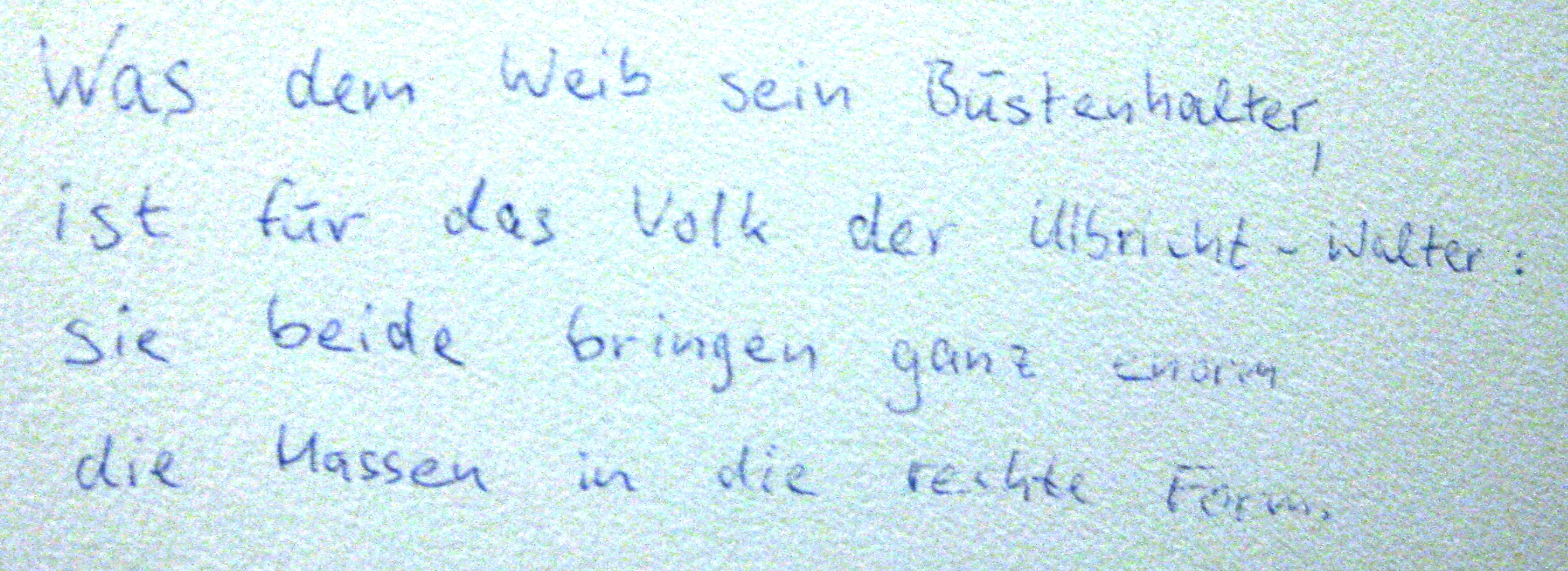
My students laugh when I tell them I study cleavage in postcommunist countries, but sometimes, by accident, the image that flashes into their minds is the correct one. Those who lament the disappearance of communist era political humor can take some solace in my recent discovery of the following poem (badly translated by me) on a bathroom wall at the University of Muenster in Westphalia.

Was dem Weib sein Büstenhalter
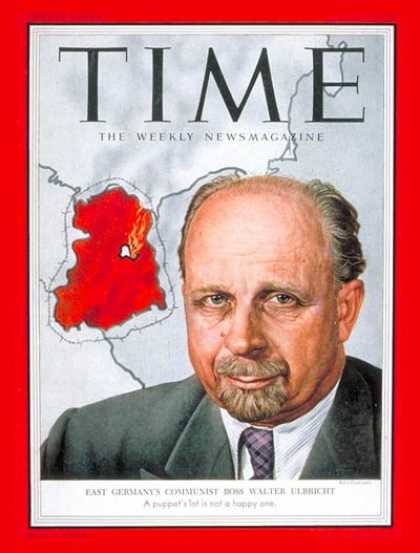
ist für das Volk der Ulbricht–Walter,
denn beide bringen ganz enorm
die Massen in die rechte Form
A woman’s bra–a Büstenhalter,
is like our leader Ulbricht (Walter),
as both compress the quite enorm-
ous masses into their proper form

I have no idea why it should appear in “West” Germany 65 years after its likely origination, but I’m glad to see the genre still around. Seeing it sparks three small side notes:

  1. Political humor has been in the news in Slovakia with an interesting but ultimately inconclusive April fool’s day article on political humor in Pravda, the most interesting part of which is the report of an entirely characteristic joke (both in form and substance) told by Vladimir Meciar in 2006:  “Meciar goes to the WC with Dzurinda and Fico and they say to him, “Why are you turning away.  Don’t be ashamed, we’re all guys here.”  To which Meciar replies, “I know we’re all guys and I’m not ashamed, but I also know about you, and that whenever you see something big Fico wants to nationalize it and Dzurinda wants to sell it to foreign investors.”
  2. SME, for its part, has posted a rather elaborate online election game which involves making the right choices for candidates: http://volby.sme.sk/hra/  Some of the questions are themselves quite funny and there’s a nice selection of Shooty’s best cartoons.
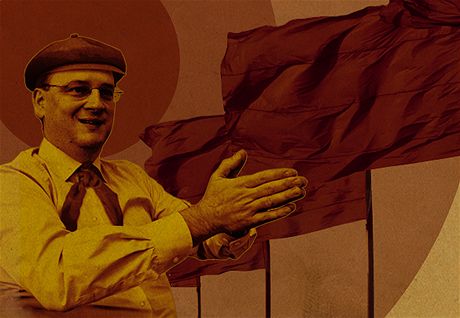
  3. In the Czech Republic MF Dnes has done some decent photoshopping to put Necas in old-style Komsomol imagery (a visualization of Paroubek’s recent joke):
  4. Finally, in searching for the Ulbricht poem above I discovered that the Büstenhalter-Walter rhyme found another life in the best possible circumstances:  the German version of Monty Python’s Lumberjack Song, in which it replaces “bra” and “papa”.  Nice job here by Michael Palin.

Dashboard News: Median offers different numbers but confirms decline of SNS and HZDS

That’s what the headlines of Slovakia’s papers should say.  But again they don’t.  Still, what we get now is better than before since the nature of differences in polling methods in Slovakia has begun to seep into the Slovak press.  Now at least the major sources specifically mention the poll by name in headlines before announcing the exciting “news” that certain new parties will not get into parliament. Pravda announces “Median: SaS and Most do not pass into parliament” while SME says almost the same thing: “Median Poll does not let SaS or Most-Hid into parliament” and TA3 writes “Median SK: SaS and Most would not get into parliament” and both SME and Pravda mentioned somewhere in the article that this differed from the results of other polls.

This is better than nothing, but not good enough.  The Dashboard contains the results including February Median poll, and what that shows is the following:

  • Median remains far from the other major pollsters on 3 important parties: SaS, Most-Hid and SNS.  This is probably because of the poll’s method of not listing party choices for respondents and requiring them to name a party without prompting.   It may be that Median is right in doing this and that the others are wrong, but Median’s past performance in predicting elections (worse than the other major pollsters: http://www.pozorblog.com/?p=684) suggests not.  So its predictions of parliamentary failure for Most-Hid and SaS, must be taken with a large grain of salt.
  • SaS:  Despite its raw numbers, Median confirms the upward trend of SaS. Median has always polled low for SaS but even with this the party now is near the threshold even for that pollster and shape of the lines (if not their locations) are roughly the same.  All major pollsters show the party with a big upward jump in January or February:
  • SNS and HZDS.  Likewise despite differences in raw numbers, Median shows a significant downward shift for both SNS, conforming to the trends in other surveys.  HZDS is now at the lowest level it has ever been in available Median polls (2005) and SNS is at its lowest level since 2007.  If Median had not showed these declines, it would be worth looking twice at the others, but the unanimity here cannot be good news, even if its raw numbers might hearten Meciar and Slota by suggesting that they are actually several steps short of the abyss.
    skp_sns

    skp_hzds

Otherwise Median numbers are not wildly different from those of the other pollsters:  in Median, as in FOCUS but not in the other two, Smer showed some recovery in February, and MKP-SMK showed signs of stabilizing above the threshold.  SDKU and KDH moved little.

Congratulations to the major papers for noticing that polling firms are different, but they still have work to do if they don’t want to miss the big story.

Dashboard News, March 2010: Stability despite overblown headlines; the importance of thresholds

No time to do a thorough post right now but a Polis came out yesterday and FOCUS came out today. Click the Dashboard above for the graphs.  Here are few thoughts:

  • Smer.  Both polls show the party slightly down but not by much.  The party has averaged between 38 and 41 for the last 6 months.  It is now on the low side of that but there are no signs of either a precipitous drop or a recovery.  Of course it will all depend on the likelihood of the “soft” Smer voters (of whom there are probably quite many) to go and vote.
  • SNS.  Polis shows a further drop to just above the threshold (but Polis has usually polled low for SNS compared to the others).  FOCUS shows it holding steady around 6%.  It probably does hang just above the threshold and its future may depend on an unlikely combination of Orban and Meciar.  We all know Orban is going to win but the tone of the campaign could help SNS a bit; if Meciar begins to fall repeatedly below the threshold, some voters might also shift to the next nearest “national” party, which is SNS.  There is still some degree of reciprocity between the voters of these parties, as with KDH and SDKU.
  • HZDS. Polis again shows it below the threshold, but Polis has usually polled low for HZDS.  FOCUS shows it with 5.2, the firm’s lowest result for the party since summer of last year.  Together these produce an average of 4.9 and so HZDS does not appear on this month’s roster of parliamentary parties.  Of course the upcoming Median survey will put the HZDS average back above the threshold, so there will not appear to be much of a change, but HZDS is clearly on the brink, and a drop like that of summer 2009 (and from a lower starting point) could knock the party out, especially if the April and May polls show it low and a few voters start to balk.
  • SDKU. Polis shows a drop from a high point; FOCUS shows a rise from a low point.  It is somewhere between 13% and 15%.  FOCUS, in particular, has shown a yo-yo, alternating between over 14 and under 12 since Fall.  Of course SDKU has been a bit of a yo-yo, with scandal followed by recovery.  Next month will help show whether the recovery shown by FOCUS is a “Radicova” bonus or just noise.
  • KDH.  In typical fashion the headline writer at the paper SME trumpeted KDH surpassing SDKU (along with a picture of Dzurinda pulling out a chair for Figel–they have pictures of elites interacting that serve every possible combination of events), but of course it probably doesn’t mean anything.  Polis puts KDH at a record high (and SDKU a bit low).  FOCUS puts KDH slightly higher.  Since FOCUS tends to poll slightly low for KDH and Polis tends to poll slightly high, the story–not one worthy of headlines–is KDH slightly up.
  • SaS.  Very little SaS news this month but that in itself is news:  FOCUS and Polis both show the party slightly down from last month, suggesting that Feburary may have been its peak.  A pre-election peak is a natural near-inevitability and is assisted by the election of Radicova to head the SDKU campaign during this period.  Watch what happens next here.   From the party’s position, the good news is that its peak and the resulting visibility is fairly high, permitting the party to sustain some losses.
  • Most-Hid and MKP-SMK. Both FOCUS and Polis show both parties slightly up, which seems unlikely in reality but which may be noise or a reaction to Hungarian-Slovak disputes.  In any case, MKP-SMK stands rather close to the threshold–too close for its comfort, I’m sure–but holds the organizational base, while Most-Hid stands higher but with a weaker voting base.  Either (but probably not both) could fall below the threshold… which brings me to a final thought.

The Importance of Thresholds.
As is to be expected these days, the Pravda headline writer announced yesterday, “Yet another poll shows opposition victory; HZDS remains below the line.”  And that is correct, as far as it goes.  The problem is “yet another” in this case means “yet another from the same polling firm” which is less surprising and that this firm has traditionally polled low for HZDS.  This is not to say that HZDS is not in trouble, but the lack of analysis is, as usual, unfortunate.  The really interesting point here–one which I do not blame newspaper writers for covering just yet–is that many parties are near the threshold and a .1% difference may shape Slovakia’s next government.  This month is an example.  The opposition and coalition are balanced closely enough that if one party from either side falls below (and there are two parties on each side near the line), it could mean victory for the other.  In the Polis poll dramatized by Pravda, it is HZDS that has fallen below, meaning that its seats get redistributed and Smer loses a partner, pushing it narrowly below the line.  Were HZDS 0.6% higher (7 more respondents in the poll), HZDS would stay above the threshold and the current coalition remains intact.  Such a small difference is not detectable by polls (even if we could get a perfectly representative sample and perfectly predict turnout behavior, it is still well within the margin of error).

It is also worth noting that an equally slight difference in SMK would put that party below the threshold and make it impossible for an “opposition” government, even if HZDS also fell below.

I hope to post more on threshold math in the near future.  Some preliminary calculations appear near the end of the Slovak Politics in a Nutshell post.

The Players: A full list of all 18 parties campaigning for parliament in Slovakia

Today’s Pravda has a useful listing of the 18 political parties that will be contesting the 2010 parliamentary election.  The list is incomplete and bit hard to use, though, so I reformat it here.  See Pravda’s story for a bit more information including a summary (in Slovak) of parties’ origins.  As one thing leads to another, so this chart has led to a more detailed analysis of the more recent comings and goings among Slovakia’s parties which will appear here as soon as I have finished a separate project.

Party Name Acronym Leader Web
New Parties
AZEN – Aliancia za Európu národov AZEN Milan Urbáni http://www.azen-eu.sk/
Európska demokratická strana EDD Antonio Parziale http://www.eds-sk.sk/
Ľudová strana Naše Slovensko LS-NS Marián Kotleba http://naseslovensko.org/
Most-Híd Most-Hid Béla Bugár http://www.most-hid.sk/
Nová demokracia ND Tibor Mikuš http://www.novademokracia.sk
Paliho Kapurková, veselá politická strana PK Pali Vass http://www.palihokapurkova.sk/
Sloboda a Solidarita SaS Richard Sulík http://www.strana-sas.sk/
Strana rómskej koalície SRK Gejza Adam
Established Parties
Smer-sociálna demokracia Smer-SD Robert Fico http://www.strana-smer.sk
Slovenská demokratická a kresťanská únia-Demokratická strana SDKU Mikuláš Dzurinda http://www.sdku-ds.sk/
Slovenská národná strana SNS Ján Slota http://www.sns.sk/
Strana maďarskej koalície – Magyar Koalíció Pártja MKP-SMK Pál Csáky http://www.smk.sk/
Ľudová strana-Hnutie za demokratické Slovensko LS-HZDS Vladimír Mečiar http://www.hzds.sk/
Kresťanskodemokratické hnutie KDH Ján Figeľ http://www.kdh.sk
Komunistická strana Slovenska (KSS) KSS Jozef Hrdlička http://www.kss.sk
Únia – Strana pre Slovensko Unia Branislav Záhradník
Združenie robotníkov Slovenska ZRS Ján Ľupták http://zrs-ur.sk/
Strana demokratickej ľavice SDL Marek Blaha http://www.mojasdl.sk/
Dead (or Hibernating) Parties
Aliancia nového občana ANO
Hnutie za demokraciu HZD
Nadej NADEJ
Lavicový blok LB
Občianska konzervatívna strana OKS
Slovenská národná koalícia – Slovenská vzájomnosť SLNKO
Slovenská ľudová strana SLS
Agrárna strana vidieka ASV
Prosperita Slovenska PS
Misia 21 – Nová kresťanská demokracia MISIA 21
Strana občianskej solidarity SOS

Dashboard News, February 2010: MVK shows Coalition Down

A new report from the polling firm MVK (the only company I know without a web address or logo) puts the current coalition down almost 5 points and the current opposition up by 6.  Here’s the poll:  http://spravy.pravda.sk/mvk-zostava-smer-hzds-a-sns-by-po-volbach-nezlozila-novu-vladu-pbp-/sk_domace.asp?c=A100309_094511_sk_domace_p12 .  But does it fit what we know from other polls?  More or less.

Coalition
As the dashboard shows, MVK’s numbers are within a plausible range nearly all parties.

  • Smer:  MVK shows a nearly 5% drop between mid-January and late February which seems rather large.  The other two polls we have (FOCUS and Polis) show the party with a slight recovery rather than a major drop during the same month, though MVK’s results did come late, however, and  it’s possible that something happened (not clear what that would be from the news) to reduce Smer support in a way that isn’t recorded yet in the other polls.
  • SNS: MVK shows a smaller loss for SNS but in some ways a more significant one because as far as I can tell from my records it is the first major poll since August 2004 to show SNS below the threshold.  Whether SNS is really that low is an open question (and one openly disputed by SNS which regards this poll as yet another election tactic by its opponents) but it is clear that every major poll has shown SNS down in recent months and the MVK poll certainly fits the trendline. Of course the party have low numbers because voters do not want to admit voting for it (this seems to have happened for HZDS during the 1990’s) but it could also have something to do with the party’s frequent scandals. Political commentators in Slovakia have argued that the party is immune to scandal because of its national message but that has struck me as rather condescending to nationalist voters. The fate of SNS will be–both for coalition development and for the overall tone of Slovakia’s politics–one of the most important questions in the coming election.
  • HZDS: MVK shows the party up a bit which is actually likely if SNS is really down. If one of these parties drops, the other is likely to be a minor beneficiary. It is fascinating, however, that the combined vote total for these parties is now down to around 10%-11%. Just two years ago the combined total averaged around 19%-20% in MVK polls.

Opposition
Most of these numbers, too, seem plausible though there is a bounce here that seems slightly unlikely:

  • SDKU: The poll shows this party up more than three points from last month which seems unlikely during a period of scandal, but last month was an exceptionally low month for SDKU in MVK and this merely returns the party to its levels for late 2009. Since the low poll came before the scandal and this more recent poll has come after (but before Radicova’s election), this would seem to offer some confirmatory evidence that the scandal did not hurt SDKU too badly, which makes some sense and gives some credit to Dzurinda for leaving the electoral list and more or less taking the scandal away with him.
  • KDH: The party’s 12.7 is the highest total (by a two point margin) that the party has received my 8 years of records of MVK polls. If SDKU were down this would make more sense to me, but it is hard to see this as anything other than a blip, even for a party that is doing better than it had in the past.
  • SaS: Is the same as last month suggesting that 1) the party has some staying power and 2) that the growth may be over. If this is SaS’s peak (and I have no way of knowing or thinking that it is) we now need to watch to see if the pre-electoral slide of new parties which hit ZRS, ANO, SOP and HZD will hit SaS and whethe it is enough. It is good for SaS that they are starting the slide from a relatively high point–at 9.2 they can lose nearly half and stay above the threshold–but not so good that there are 3 months in which to do it.
  • MKP-SMK and Most-Hid. Both are down slightly from last month’s MVK and Most-Hid is near the threshold of viability by these standards. I have no way of evaluating what the right level is; other polls have tended to put Most-Hid above SMK in recent months so MVK is different but not to be discounted for that reason. The real question is whether one of these two parties begins to fall short of 5% whether voters will flock to the other. The worst case scenario for Hungarians (short of both parties falling short of 5% which I still think is unlikely) is for one of these two parties to get nearly but not quite 5%. Right now the numbers make that a strong possibility. This means we have a 50%-50% chance of the best and worst-case scenarios (both in v. one weak party in) as opposed to a much stronger chance of a middle-of-the-road scenario (one marginally stronger party in, one weak party out).

Finally, a plea: Would MVK please include full results in its press releases as FOCUS and Median do. Perhaps it would help if journalists demanded them.

Slovakia’s politics in a nutshell

Everything you never wanted to know about politics in Slovakia and were therefore afraid to ask (lest I’d tell you).  I’ve finally had a chance to annotate an absurdly long and detailed presentation on Slovakia’s politics which derived in large part from the exercises I’ve been conducting on this blog (and past efforts).  The questions, some of which are rigorously answered in this presentation (and others of which I speed through hoping you’ll take my word for it):

  • What is politics in Slovakia about?  What is the struggle
  • Where is the power?
  • What are the parties like?  Their history, organization, voters, recent poll performance
  • What coalitions are possible after the elections?  Which are most probable?  Why?

Much of this is conjecture on my part, though I’ve tried to ground it as well as I could in data.  As always, I crave comments lest I write out into the void.

There are two versions:

American Politics in a Nutshell

imagesI am a comparativist by training and so it is not particularly surprising that I am fond of  T. S. Eliot’s famous quatrain from Little Gidding:

We shall not cease from exploration
And the end of all our exploring
Will be to arrive where we started
And know the place for the first time.

And I am therefore extremely grateful to Michal Kovacs of the Introduction to North America class at the Economics University of Bratislava for the chance to reverse the normal equation and talk about my own country using the tools that I usually use to talk about Slovakia.  Thanks, too, to the students who paid close attention and asked excellent questions (but I’m still not telling whom I would vote for if I were a citizen of Slovakia).  For those students who participated and for anyone else odd enough to care, a hasty, non-annotated (and therefore probably incomprehensible) .pdf of the talk is available here:

Since this is in many regards just a highly abbreviated version of lectures in my Citizenship class, the truly foolhardy can find a more extensive treatment at http://waynehonorsgold.pbwiki.com (login: waynehonorsgold@yahoo.com, login: abercrombie)

In the news: Slovak Spectator article on parties (Warning: Self-promotion alert)

Just a note to cite a very nice article by Michaela Stankova in the Slovak Spectator on political parties.  Not only is the article completely faithful to our email interview, but it does a nice job of balancing our conversation with comments from others including Miroslav Kusy.  The complete article is here:

Polls, Politics and Parties, Part 5: Who with Whom? Doing the coalition math

coal allWith 8 parties potentially entering Slovakia’s parliament there are 255 different coalition possibilities.  Fortunately, not withstanding Bismark’s aphorism that “Politics is the art of the possible,” there are quite a few coalition possibilities that we can exclude and in the end we can narrow down the possibilities to a relatively small number.  In the paragraphs below, I do this as systematically as I can by excluding (with great care) individual relationships that simply will not work and ranking others by probability, and then with guesses about which of the remainder will manage to muster a sufficient number of seats.  Those who don’t want to read the whole process by which I reached the answer can jump down to the bottom and look at the pretty graph:

Coalition (im)possibilities: What can we exclude?

I heartily accept Charles Dudley Warner’s conclusion that “Politics makes strange bedfellows” and I am no longer surprised when lifelong enemies join forces against a new opponent, so it is a dangerous business to say that “Party A” will not form a coalition with “Party B.”   In fact, as I learned the hard way, it is still a dangerous business even when the leader of “Party A” has said it himself.  For example:

(HZDS leader Vladimir) Meciar only ruled out post-election cooperation with the Slovak National Party (SNS). “This is because of its low political culture, vulgarism, and inclination toward unethical behavior, and I cannot cooperate with Jan Slota (SNS leader).” Sme, Tuesday, April 11, 2006 T08:49:17Z:

Since this statement led me to discount the combination that emerged 3 months later and that has governed in Slovakia during the past four years, I now think it wise to seek out other standards.  What leaders say can be helpful but only if backed up by something else.  Unfortunately, that something else is the rather insubstantial notion that barring alien invasion, some parties very reasons for being exclude coalitions with other parties and whose electoral existence would be threatened by the combination.  There are only a few of these:

  • Slovak National and Hungarian National:  It is hard to envision a coalition between the Slovak National Party (SNS) and the Hungarian parties, Most-Hid and MKP-SMK.  It would be very hard for the Slovak National Party to accept partnership with parties it tried to ban, even if the Hungarian parties were willing to accept.
  • Left and Right:  It is hard to envision a coalition between Smer and Freedom and Solidarity (SaS) or the Slovak Democratic and Christian Union (SDKU).  This one’s a bit less certain because the economic dimension is not quite as bitter as the national one, but from its beginning SaS pointed to Smer as its chief opponent and differentiated itself from other parties on its same side of the political spectrum (especially SDKU) precisely on its unwillingness to form a coalition with Smer.  For an older, more established party, it might be possible to go back on the promise, but SaS doesn’t have too much else to offer.

coal1This reduces the range of party relationships a bit and drops the total number of coalition permutations to 119:

The next step is to eliminate combinations that are highly unlikely, on the basis of leader statements backed by some fundamental opposition that would cost a party major support if it joined with another.  Here I would suggest several candidates:

  • Right and Slovak National: KDH, SDKU and SaS are highly unlikely to form a coalition with SNS.  It is not impossible that right-wing parties might join with SNS, but it is hard to imagine the circumstances.  SNS has used such strong national rhetoric and has faced so many corruption allegations that even Smer has found the combination difficult.  For the right wing parties, whose voters are less nationally oriented and who are likely more sensitive than Smer to the opinions of international partners, the combination would be even more difficult.  Furthermore, any seats that SNS would bring to a right-wing coalition would be more than offset by the loss of any possibility of Hungarian seats.
  • Let and Right: It is also hard to envision a coalition between Smer and SDKU.  At one time the combination seemed utterly impossible given Fico’s hatred for Dzurinda; now that Dzurinda will no longer be the electoral leader of SDKU, it might be a bit easier, but Fico has just as much disdain for one of the leading candidates for SDKU leader–Miklos–and the other leading candidate, Radicova has recently sharpened her rejection of this kind of coalition.

coal2Since coalitions can occur only if all parties are willing to pair with all others, this drops the number of permuations to a (slightly) more reasonable 83.

In addition to these, there are a number of hard relationships, those which would be made difficult either by personal animosity or by potential loss of support.  This category—where I should have placed HZDS-SNS in 2006—is a bit larger but doesn’t help us much as it merely raises the cost of coalitions rather than preventing them altogether.  Still, these combinations are worth noting as “expensive”

  • Right and Slovak national.  It is not impossible to exclude a coalition between HZDS and KDH, SaS, MKP-SMK and Most-Hid, but past conflicts between HZDS and the right and Hungarian national parties are still vivid enough that such a coalition, while possible, would not be easy.  KDH in particular has resisted any connection with HZDS but the Hungarian parties are also disinclined.  SaS leader Sulik has moved from a statement that a coalition with HZDS would be a lesser evil, to a statment that HZDS leader Meciar should be “behind bars.”
  • Left and Right.  The only left-right coalition not excluded above is Smer with KDH.   This is the one that is merely unlikely rather than hard to imagine.  The coalition would be hard to accept for Smer voters and especially hard for KDH voters.  Recent comments by KDH chair Figel about Smer are sharper than in the past and a coalition would likely hurt KDH with its supporters, but it can’t be excluded entirely.
  • Left and Hungarian national.  Both Hungarian parties, for their part, seem desirious enough of entering government that they would probably be able to overlook Smer’s past rhetoric on national questions but Smer has put a lot of energy into criticizing Hungarians and so would find it difficulty (though probably not impossible) to choose a Hungarian partner as it would lose a relatively strong electoral appeal.  Since, as below, Most-Hid and MKP-SMK are not getting along well at the moment a coalition between Smer and only one of the Hungarian parties would be slightly less fraught, but might be no more desirable to Smer and would have a lower chance of gaining a majority.
  • Hungarian and Hungarians.  Ultimately a conclusion may well include MKP-SMK with Most-Hid but doing so will take some work as the leaders of the two parties dislike each other intensely and the rhetoric has becoming sharper.

coal3

We can also do a preliminary assessment of the mathematical possibilities of coalitions, using a maximalist version of current party support.  A coalition of SDKU and SaS might work nicely but the party has no practical chance of a parliamentary majority.  We can exclude electorally impossible coalitions by taking current poll results and (for safety’s sake) giving each party a 30% bonus (assuming maximal poll error in a party’s favor).  This brings the number of even barely viable coalitions down to “only” 27.

From this, furthermore, we can remove 7 coalitions as containing redundant members (eliminating the smallest still leaves more than 80 seats by current estimates).  This brings us down to 19.

Coalition possibilities: What’s left:

For simplicity we can further categorize these coalitions by similarities among members.  The graph below tries to makes sense of these many options by comparing them along two axes:  from left to right a internal compatibility of coalitions (related to the “expensiveness” of coalition pairings discussed above but based on my own highly-arguable judgment rather than any quantitative measure) and from bottom to top an expected number of seats based on current month polls.  Least likely coalitions are in the lower left; most likely in the upper right.

coalition matrix

The coalitions in terms of likelihood are, therefore:

  • coal lsnSmer + Slovak National:  From an electoral perspective, the current coalition has a strong chance of return, and is not utterly unpalatable for the coalition members.  Slightly more internally compatible would be a subset of the current coalition—Smer with either HZDS or SNS—but this has a somewhat lower chance of sufficient electoral success.
  • coal lhnSmer + Hungarian National: A coalition between Smer and both Hungarian parties is electorally possible but less mutually desirable by its member.
    • Smer + Hungarian National + Slovak National: Adding HZDS to this mix is theoretically possible but probably would not be necessary in electoral terms and would add consideral internal incompatibility
  • coal lrSmer + Right: It is hard to imagine a coalition between Smer and a “right” party except KDH and even this would be unappetizing for Smer (though perhaps moreso than a coalition with Hungarian parties) and even less so for KDH.
  • Right + Hungarian National: A coalition resembling the 2002-2006 Dzurinda government is coal rhncertainly a possibility in terms of internal compatibility (these parties conflicted with one another when in government but seem willing to tolerate one another rather than see another Fico government).  From an electoral perspective, however, these are highly unlikely.
    • Right + Hungarian National + Slovak National: Adding HZDS to this coalition could perhaps coal rhnsnpush this coalition into a parliamentary majority but only by adding so much internal incoherence as to make it highly unlikely.  It is hard to imagine what incentives could inspire HZDS to chose this coalition rather than one with Smer but the party is certainly relying on having more bargaining potential than SNS, for whom Smer is the only coalition choice.

Both of these are only very rough indicators of the actual factors (coalitionability and electoral strength) but they are the best I can come up with at the moment.  I will try to nuance these as the election nears.  One nuance, worth thinking about now, however, is the fact that Slovaka’s electoral system does not make a smooth equivalence between seats and votes but rather imposes (as most countries do) a 5% threshold.  Since 5 of Slovakia’s 8 major parties have support near 5%, a small change in support can have major impact on the composition of parliament and these deserve consideration in the next post.
Dashboard News: Unhappy Median, January 2010

medianFor once I’ll get the lead on the Slovak press and talk about a poll first, the results of which I have added to the Dashboard.  Median published its January poll results today and they have their effects on the overall averages, pushing the MKP-SMK average below 5% for the first time in my dataset, while flattening out the sharp rises of Most-Hid and SaS and softening the drop of HZDS and SNS.  We shall see how the press covers it (“CSAKY, BUGAR AND SULIK FALL SHORT!”) but in the context of other polls, its’ rather hard to accept.  There are lots of ways to analyze this but for the sake of time and simplicity I’ll simply compare Median to the other three polls taken at approximately the same time (MVK, FOCUS, Polis).  On the two biggest parties, Smer and SDKU, the Median result is right in line but on all the rest it stands out to a remarkable degree.  Long-established Slovak parties (SNS, HZDS and KDH) score high in Median’s poll.  Very high.  Meanwhile newly established parties (and SMK) score low.  Very low.  In fact, for all six of these parties, the Median poll result is not only the outlier, but its addition more than doubles the range of poll values or more (x3 for HZDS, x4 for SAS and x6 for SNS).  In other words Median results are more different from the nearest of the three other polls than any of those polls are from one another, as the graph below shows.

Where Median polls high Where Median polls low
SNS HZDS KDH MKP-SMK Most-Hid SaS
Median 9.6 9.3 11.3
Highest of other 3 polls 6.2 5.8 10 6.7 6.4 9.6
Lowest of other 3 polls 5.6 4.1 8.9 5.1 5.6 8.1
Median 3.3 4.3 2.7
Largest difference between other 3 polls 0.6 1.7 1.1 1.6 0.8 1.5
Difference between Median and nearest of other 3 polls 3.4 3.5 1.3 1.8 1.3 5.4

As I’ve discussed before, this may have a lot to do with Median’s unorthodox procedure of not providing a list of parties to choose from.  But  what to do with these results?  I’m loathe to eliminate them as I suspect they capture some kind of political truth (some people when shown names of new parties in polls pick them but revert to long standing loyalties and remembered names in the voting booth) but they do ignore another (the inability of people to remember the name of the new party they’re interested in).  And the firm’s past performance suggests that it’s take on the political truth does not much help us predict final results (http://www.pozorblog.com/?p=684).  Median may thus act as a useful corrective but simply cannot be looked at in isolation.